
Listen
Picture a Monday morning in an ordinary office. A colleague reads the same email for the third time. He is not ill, not lazy and not by nature distracted. Over the weekend he opened a letter from the tax office, and he has not been able to put it down since. That Monday appears in none of the company’s figures. It gets paid for all the same.
Money worries are treated as a private matter, something settled at home or not at all. In fact they are a bill that everyone pays, except that nobody sees it.
A new title at the United Nations
How seriously the subject is now taken shows in an unassuming change of title. Since 2009 Queen Máxima of the Netherlands had served as the UN Secretary-General’s Special Advocate for Inclusive Finance for Development. On 25 September 2024 she was given a new mandate: Special Advocate for Financial Health.1 The reasoning fits into one sentence. The rails have been built, and almost anyone can now open an account. The question is whether people can get through the month, and through a crisis, with what is in it.
Her office defines financial health as the extent to which a person or family can smoothly manage current financial obligations and have confidence in their financial future.2 Its 2025 annual report cites the World Bank’s Global Findex: in low and middle income countries, only a third of adults could cover two months of expenses after losing their main income.2
The costs nobody books
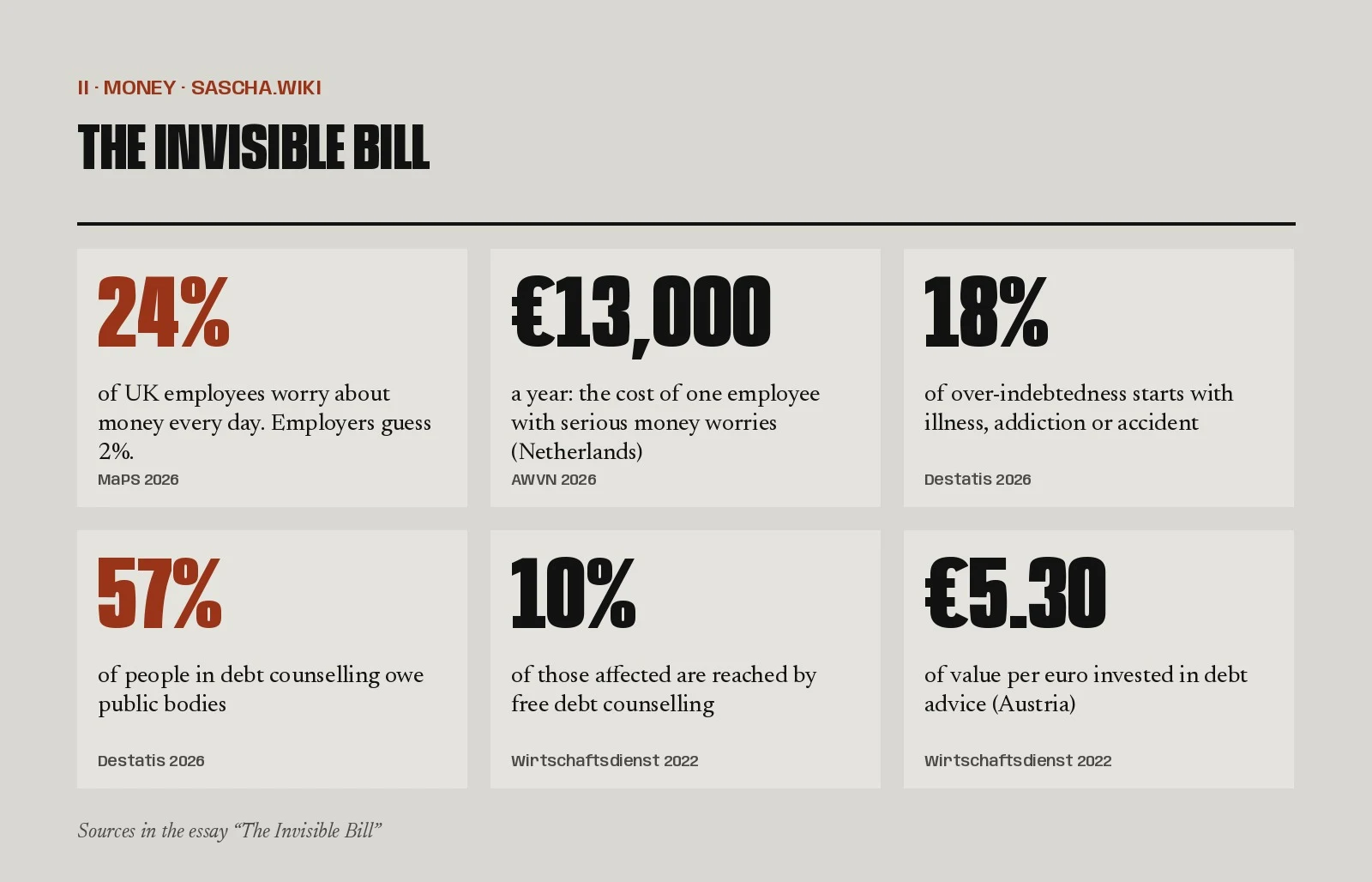
The invisible bill is easiest to see at work. The UK’s Money and Pensions Service asked employers how many of their staff worry about money every day. They guessed 2%. The staff themselves said 24%.3 The same body counts 13 million working days lost to money worries in 2021, and absence that costs British employers up to £2.5bn a year.3
The Dutch employers’ association AWVN puts the cost of one employee with serious money worries at around €13,000 a year, in absence, lower productivity and paperwork.4 In Japan, a nation of savers by reputation, 36% of more than 11,000 employees of listed companies told Nomura that money troubles cost them concentration at work, a loss of working time not much smaller than that caused by health problems.5 No company would ignore an illness that ate so much of the working week. With money worries, almost all of them do.
The most expensive money worry is the one nobody mentions.
Debt is more often an accident than a spree
The cliché of the over-indebted is a shopper who lived beyond their means. The data tell another story. Among people in German debt counselling in 2025, illness, addiction or accident was the most common main trigger, at 18%, just ahead of unemployment.6 Consumer behaviour plays the leading role in only 9.7% of cases, according to the iff over-indebtedness report, while those seeking advice spend 48% of their income on housing against 26% for the population as a whole.7 In all, Germany’s SchuldnerAtlas counts some 5.67 million over-indebted adults.8
Then the arrow turns round. About half of people in problem debt in Britain also have a mental health problem, and those who are depressed and in debt are 4.2 times as likely to still be depressed 18 months later.9 A Swiss study of 4,388 adults found that financial hardship roughly doubled the odds of insomnia.10 Money makes people ill and illness makes them poor. The only question is where to break the circle.
The state as creditor, and as payer
One place is surprisingly close to home. Around 57% of people in German debt counselling in 2025 owed money to public bodies, more than to any other kind of creditor.6 The state collects the debts and later pays for the consequences: benefits, treatment, lost output.
Meanwhile Germany’s free debt counselling is estimated to reach only about 10% of the people who need it.11 That is remarkable, because it pays. Older studies put the social return in Hamburg at roughly twice the money spent, and in Austria at €5.30 for every euro invested.11 In Britain, Citizens Advice puts its savings to government and public services in 2024/25 at £783m.12 Cutting advice to save money is a saving that costs more than it saves. In a household, that would be a case for debt counselling.
Why a leaflet is not enough
The usual answer to money worries is education. The research is sobering and comforting at once. A large meta-analysis in 2014 found that financial education explained just 0.1% of financial behaviour and that its effect faded after about 20 months.13 A newer review of 76 randomised trials is kinder: the effects are real, if not large.14 Knowledge helps, then, but rarely on its own.
The Special Advocate’s office therefore stresses products that move people from knowledge to action,15 and points to British employers testing automatic emergency savings with the right to opt out.2 The Netherlands has formed a national coalition with the aim of halving the number of financially unhealthy households by 2030.16 In 2025, 44% were still classed as vulnerable or unhealthy.17
What helps is less heroic than one might think. Employers can set a small emergency fund through payroll as the default. Public bodies can collect what they are owed without pushing people further under. Governments can fund advice that demonstrably pays for itself. And each of us can say a number out loud sooner than feels comfortable. The most expensive money worry is the one nobody mentions. It appears on no balance sheet, and it is paid every month regardless.
Sources
- UNSGSA: UN Event Marks 15 Years of Financial Inclusion and New Financial Health Mandate for the UNSGSA, 2024-09-27
- UNSGSA: UNSGSA 2025 Annual Report to the UN Secretary-General, 2025-09-26
- Money and Pensions Service (UK): Essential Guide for Employers 2026: Financial wellbeing in the workplace, 2026
- AWVN: Werkenden met geldzorgen en de rol van werkgevers, 2026-01-26
- Nomura: 第5回ファイナンシャル・ウェルネス(お金の健康度)アンケート(2025年実施), 2025
- Statistisches Bundesamt (Destatis): Überschuldung am häufigsten durch Erkrankung, Sucht oder Unfall ausgelöst (Pressemitteilung Nr. 249), 2026-07-15
- iff Hamburg: iff-Überschuldungsreport 2025 (Pressemitteilung), 2025-10-01
- Creditreform: SchuldnerAtlas Deutschland 2025, 2025-11-14
- Money and Mental Health Policy Institute: Money and mental health: the facts, 2026-06-29
- HES-SO (Lorthe et al.): Perceived financial hardship and sleep in an adult population-based cohort, 2025
- Wirtschaftsdienst: Zur Stärkung der Sozialen Schuldnerberatung ist sofortiges und entschlossenes Handeln der Politik gefragt, 2022
- Citizens Advice: All our impact (2024-25), 2025
- Management Science (Fernandes, Lynch, Netemeyer): Financial Literacy, Financial Education and Downstream Financial Behaviors, 2014
- Journal of Financial Economics (Kaiser, Lusardi, Menkhoff, Urban): Financial Education Affects Financial Knowledge and Downstream Behaviors, 2022
- UNSGSA: UNSGSA Queen Máxima to Elevate Financial Health at 2026 Spring Meetings, 2026-04-15
- Banken.nl: AFM sluit zich aan bij Nationale Coalitie Financiële Gezondheid, 2025-02-14
- Accountant.nl: Financiële gezondheid Nederland verbetert, maar veel huishoudens nog financieel kwetsbaar, 2026-04-28