
Listen
Soundtrack to the essay · Thinking Is a Public Act
Foyer
Melodic techno, hushed and communal like a theatre foyer at the interval: crowd murmur, choir-like pads.
Intro
The long interval, everyone in the foyer
Verse
Our certainties stepped out for a drink
Nobody is sure they will come back for the second act
The feed agrees with us and never stays for long
Drop
We don’t meet because we trust
We trust because we keep meeting
Verse
Looking away is a habit, not a law
Think out loud, in a room with other people in it
Drop
We don’t meet because we trust
We trust because we keep meeting
Outro
Back for the second act
Music and vocals are AI-generated; the lyrics draw on the essay. The EBM version is instrumental. All twelve pieces: Rethink Future 2027.
Some years feel like a long interval at the theatre. The old certainties (that the news is broadly reliable, that institutions will muddle through, that the neighbours share at least a few of our assumptions) have not been abolished. They have stepped out into the foyer, and nobody is sure they will be back for the second act. The question is how we live together in the meantime. My answer is unfashionable: thinking is a public act, and it gets worse when we do it alone.
A break from certainty
The numbers describe a society leaning back from the table. The Reuters Institute’s Digital News Report 2026, published in June and covering 48 markets, found that trust in news has fallen to 37%, the lowest figure since the institute began measuring in 2015.1 In Germany 46% still say they trust the news overall, a respectable showing by current standards; in the United States the figure is 25%.2 3
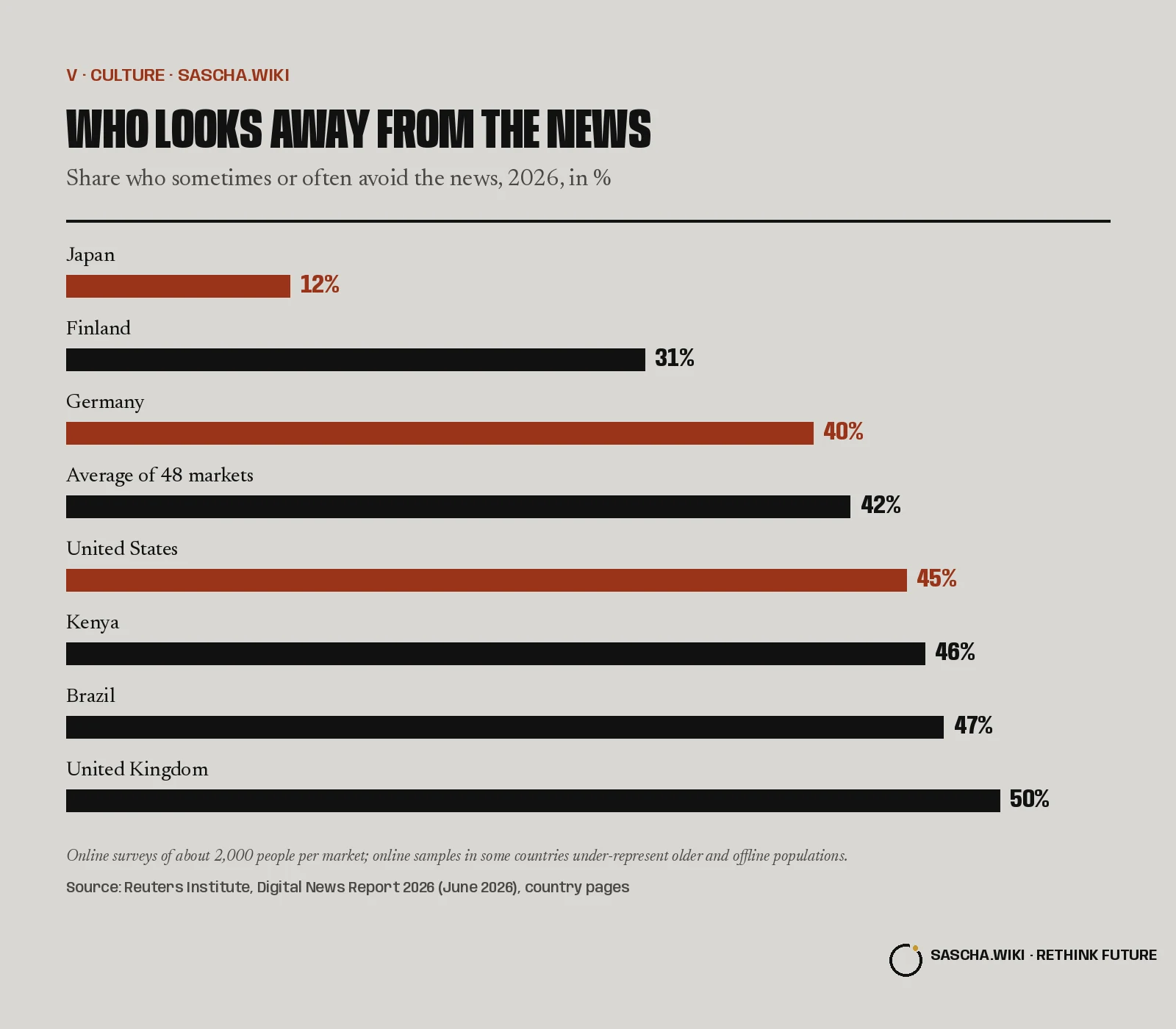
Avoidance tells the sharper story. Across all markets, 42% say they sometimes or often avoid the news, a number that has settled rather than recovered.1 In Germany it is 40%, up three points on the year; in the United States 45%; in the United Kingdom, half the population.2 3 4 Even Finland, the perennial star pupil, sits at 31%.5 Japan is the outlier at 12%.6 On other continents the pattern rhymes: 46% in Kenya, 47% in Brazil.7 8 Turning away from the news, in other words, is not a law of nature. It is a habit, and habits have a dialling code.
The quiet exit
Avoiding the news would be harmless if we replaced it with conversation. Mostly we replace it with the feed, which is conversation’s clever cousin: always available, never awkward, and arranged so that nobody at the table disagrees with us for long. The 2026 Edelman Trust Barometer, based on interviews with nearly 34,000 people in 28 countries in late 2025, gave this retreat a name: insularity. Seven in ten respondents said they were unwilling or hesitant to trust someone with different values, backgrounds or sources of information. In Germany the figure was 81%, in Japan 90%, in the United States 70%.9
Note the Japanese paradox: a country that rarely turns away from the news, and yet hesitates more than any other to trust the stranger with different views. Staying informed and staying in touch are, it turns out, two separate skills.
The cost is not only civic. In June 2025 the WHO Commission on Social Connection reported that one in six people worldwide is affected by loneliness, and linked loneliness and social isolation to more than 871,000 deaths a year, roughly 100 every hour.10
I spent a good part of my working life in direct marketing, for Microsoft, Quelle and Condé Nast, which is to say I was once paid to reach people while they sat alone at their kitchen tables. I can report that the feed does it better, and saves on postage.
We do not meet in shared places because we trust one another. We come to trust one another because we keep meeting.
Rooms with other people in them
Picture a Tuesday evening in the public library of a mid-sized German town. A reading group of seven, one of whom has not read the book. A student arguing with a retired engineer about whether the novel is about the war or about the author’s father. Nobody is right, which is precisely the point. The disagreement has faces, and it ends with coats being put on rather than accounts being blocked.
The café, the library, the town hall meeting and the letters page were never efficient. They were slow, occasionally tedious and full of people who talked too long. But they did something a feed cannot: they made us think in front of witnesses. An opinion said aloud to someone across the table has to survive that person’s expression. An opinion posted into a feed only has to survive the algorithm, which is a far more forgiving audience.
The case for thinking out loud
Thinking out loud is not the same as broadcasting. It means offering a half-formed idea and allowing other people to improve it, which requires a degree of trust we no longer extend lightly. Yet trust is not the precondition of public thinking; it is the by-product. We do not meet in shared places because we trust one another. We come to trust one another because we keep meeting.
None of this needs a national programme. It needs a chair. A library that stays open in the evening. A café that does not mind two people arguing over one coffee for an hour. A newspaper that prints the letter it disagrees with. A school that treats debate as a subject rather than a disturbance.
The old certainties may return from the interval, or they may not. Until then the honest course is to think where others can hear us, and to be overheard, now and then, being wrong. It is less comfortable than scrolling. It is also, as far as I can tell, the only way a society has ever changed its mind without breaking something first.
Sources
- Reuters Institute for the Study of Journalism: Digital News Report 2026: Overview and key findings, June 2026
- Reuters Institute for the Study of Journalism: Digital News Report 2026: Germany, June 2026
- Reuters Institute for the Study of Journalism: Digital News Report 2026: United States, June 2026
- Reuters Institute for the Study of Journalism: Digital News Report 2026: United Kingdom, June 2026
- Reuters Institute for the Study of Journalism: Digital News Report 2026: Finland, June 2026
- Reuters Institute for the Study of Journalism: Digital News Report 2026: Japan, June 2026
- Reuters Institute for the Study of Journalism: Digital News Report 2026: Kenya, June 2026
- Reuters Institute for the Study of Journalism: Digital News Report 2026: Brazil, June 2026
- Edelman: 2026 Edelman Trust Barometer Reveals Trust Is in Peril as Society Slides into Insularity, 2026-01-18
- World Health Organization: Social connection linked to improved health and reduced risk of early death (report of the WHO Commission on Social Connection), 2025-06-30