

Listen

Soundtrack to the essay · Hands Up Is Not a Strategy
Hundred Days
Melodic techno, a grey October morning turning resolute: a rising arp, a bright lift after the drop.
Intro
The alarm still rings, out of loyalty
Verse
A calendar that finally says nothing
No stand-up at nine, no call at four
The coffee slow for the first time in ten years
Drop
Sort, speak, begin
Hands up is not a strategy
Verse
Eighty days is what the waiting costs
The money can be counted again, the mirror cannot
Drop
Sort, speak, begin
Hands up is not a strategy
Outro
A hundred days before the paint dries
Music and vocals are AI-generated; the lyrics draw on the essay. The EBM version is instrumental. All twelve pieces: Rethink Future 2027.
Picture a Monday in October. The alarm goes off at the usual time, out of loyalty. The calendar, which for years complained of overbooking, now has the decency to say nothing at all. No stand-up at nine, no call with Chicago at four, nobody asking whether you have “a quick minute”. The coffee is drunk slowly for the first time in a decade, and it is not as pleasant as the brochures for early retirement suggest.
This essay makes one claim: the first hundred days after losing a job decide less about money than about self-image. Money is a spreadsheet; it can be recalculated. The picture a person holds of themselves is harder to repaint once the paint has dried, and it dries quickly.
A world of quiet Mondays
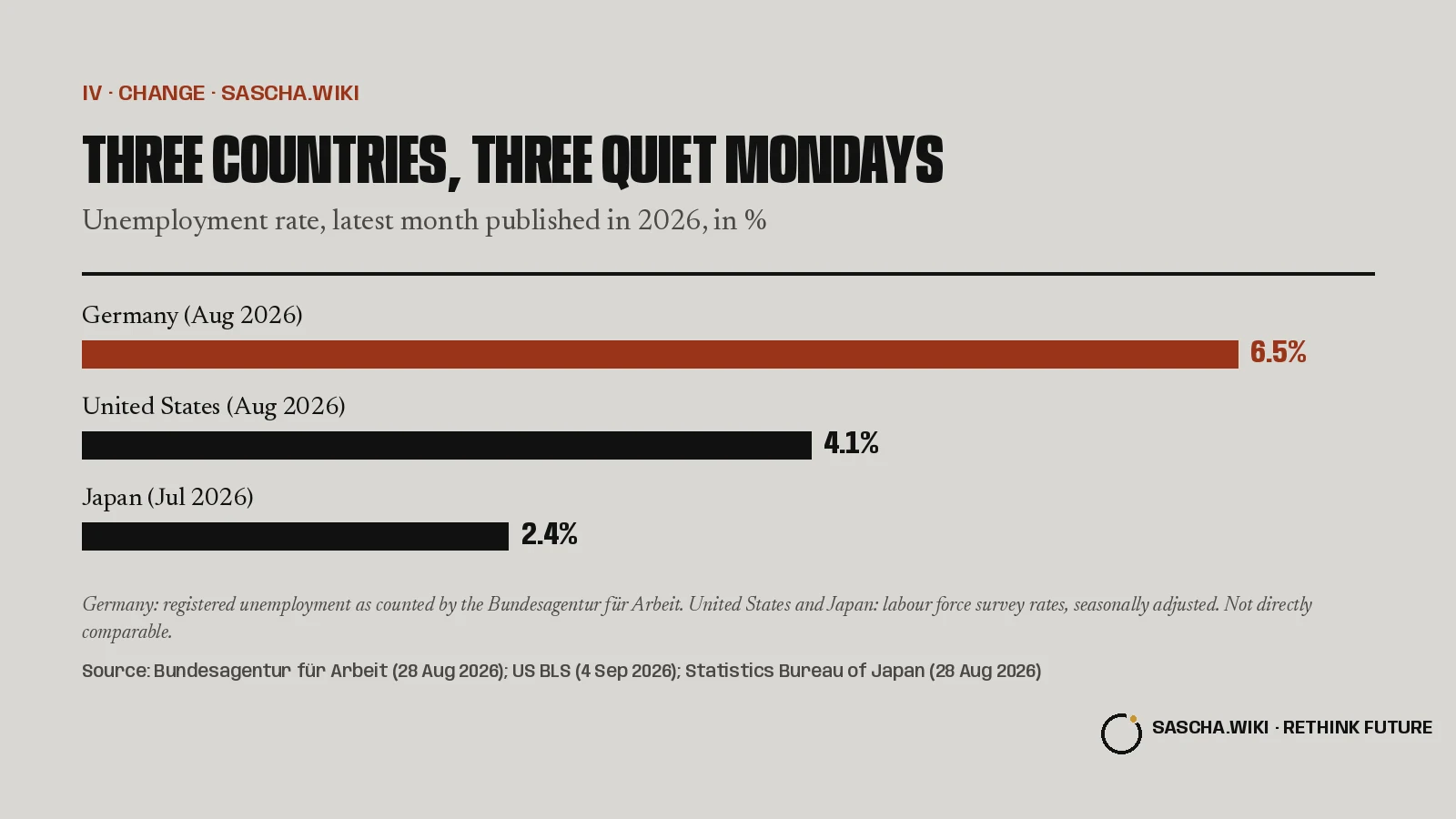
The quiet Monday is not a private affair. In August 2026 the Bundesagentur für Arbeit counted 3,061,000 registered unemployed people in Germany, a rate of 6.5%, and its chair, Andrea Nahles, noted little movement beyond the usual seasonal pattern.1 In the United States the rate stood at 4.1% in the same month, or 7.0 million people.2 Japan, which has turned low unemployment into something close to a national discipline, reported 2.4% for July: still 1.69 million people.3
The clock matters more than the headline. The median unemployed American in August had been looking for 11.4 weeks, roughly eighty days.4 More than a quarter, 27.0%, had been out of work for 27 weeks or longer.2 A hundred days, in other words, is not a figure borrowed from newly elected governments. It is roughly the stretch in which a gap in a CV is still an episode rather than a story that other people tell about it.
Sort
The first rule is dull and therefore usually skipped. Sort the papers, the deadlines, the accounts, the contract clauses nobody read while things were going well. In Germany, anyone who learns of a dismissal less than three months in advance must register as a jobseeker within three days, or lose a week of benefit. In 2025 the Bundesagentur imposed 326,600 such penalty weeks for late registration alone, 41.2% of all 792,000 it handed out.5 One suspects that many of these people did not lack the information. They lacked the wish to make it official.
Sorting is not bureaucratic hygiene. It turns an event that happened to you into a set of tasks you perform. The first is passive, the second is not, and the difference is felt long before it shows up on any bank statement.
Waiting for the market to call is therefore a strategy in the same sense that hoping is a pension plan.
Speak
The second rule is harder. Job loss is among the most thoroughly studied of life’s misfortunes, and the findings are consistent. A meta-analysis of 38 longitudinal studies, published in 2025, found that unemployed people were roughly twice as likely to report mental health problems as those in regular work (relative risk 1.95).6 Silence makes it worse. In a survey by Germany’s Institute for Employment Research (IAB), almost 90% of long-term unemployed respondents believed that most people were prejudiced against the jobless, and nearly 30% tried, in certain situations, to conceal their unemployment.7
Concealment is expensive. It costs the energy of maintaining a version of oneself, and it closes the channel through which many openings still travel: people who know you are available. The IAB found something else worth noting. Those who felt most stigmatised did not give up; they searched harder, through more channels, and spent more time on it. The effort simply did not translate into more interviews.7 Diligence without disclosure is a treadmill. Speaking early, to a partner, a former colleague, a doctor if the nights grow long, is not a confession. It is logistics.
Begin
The third rule is to begin something before the right thing appears. Not a grand project; a small one with a date attached: a course, a piece of writing, a stretch of unpaid work for a cause that needs it. The German labour market is not generous at the moment. The IAB noted in March 2026 that the job prospects of the unemployed slumped in 2020 and again in 2022 and have not recovered since, while long-term unemployment stands more than 300,000 above its pre-pandemic level.8 Waiting for the market to call is therefore a strategy in the same sense that hoping is a pension plan.
The meta-analysis that measured the damage also measured the repair: people who found work again had a risk of mental health problems about a third lower than those who remained unemployed (relative risk 0.66).6 Work, it seems, gives back part of what its loss took away. Beginning early is a way of reclaiming some of it before the payslip does.
Raising one’s hands is the gesture of surrender, and in the first week it is an understandable one. After a hundred days it hardens into a posture. Sort, speak, begin: none of it pays the rent. All of it decides who the person paying it will be.
Sources
- Bundesagentur für Arbeit: Arbeitsmarkt im August 2026 (Presseinfo Nr. 31), 2026-08-28
- U.S. Bureau of Labor Statistics: The Employment Situation: August 2026, 2026-09-04
- Statistics Bureau of Japan (総務省統計局): 労働力調査(基本集計)2026年7月分 / Labour Force Survey, monthly results July 2026, 2026-08-28
- U.S. Bureau of Labor Statistics via FRED, Federal Reserve Bank of St. Louis: Median Weeks Unemployed (UEMPMED), August 2026, 2026-09-04
- Bundesagentur für Arbeit: Rechtzeitig arbeitsuchend melden: Chancen nutzen, Sperrzeit vermeiden, 2026-09-03
- Occupational and Environmental Medicine (Sterud, Lunde, Berg, Proper, Aanesen): Mental health effects of unemployment and re-employment: a systematic review and meta-analysis of longitudinal studies, 2025-09-10
- Institut für Arbeitsmarkt- und Berufsforschung (IAB), IAB-Forum (Gerhard Krug): Weder faul noch resigniert: Wie Langzeitarbeitslose mit dem Stigma der Arbeitslosigkeit umgehen, 2020-05-27
- Institut für Arbeitsmarkt- und Berufsforschung (IAB): IAB-Kurzbericht 5/2026: Arbeitsmarktentwicklung 2026: Fiskalpolitischer Rückenwind trifft auf geopolitischen Gegenwind, 2026-03-24