
Listen
Soundtrack to the essay · Twelve Small Decisions
Sixty-Six Days
Melodic techno, patient and quietly determined: a plucked motif that grows with every bar.
Intro
January, a car park full of vows
Verse
New shoes, grave faces, by March it is empty again
Nobody fell, the promise simply wore off
Drop
Sixty-six days, not twenty-one
A small decision, again and again
Verse
Lay the clothes out the night before
A vow needs a year, a choice needs a Tuesday
Drop
Sixty-six days, not twenty-one
A small decision, again and again
Outro
Until it stops being a decision
Music and vocals are AI-generated; the lyrics draw on the essay. The EBM version is instrumental. All twelve pieces: Rethink Future 2027.
Picture the first Monday in January at a gym on the edge of any German town. The car park is full, the changing room is full, and the person on the next machine has new shoes and an expression of great moral seriousness. By March the car park has its old shape again. Nobody failed dramatically. The resolution simply wore off, like the smell of new shoes.
The thesis here is modest: change rarely comes from the size of a resolution, and usually from a small decision repeated until it no longer needs deciding.
The January arithmetic
Resolutions have not gone out of fashion. In a Forsa survey of 1,002 people for the health insurer DAK-Gesundheit, conducted in November 2025, 41% of Germans said they had made resolutions for 2026. The favourites: more time with family and friends (62%), less stress (61%) and more exercise (57%). A record 36% wanted to spend less time on their phones and online.1 Americans are more reserved. In a YouGov poll from December 2025, 31% said they would make a resolution or set a goal for 2026, and only 39% of those were sure they would keep it all year.2
The German figures contain a pleasant surprise: 63% of those asked said they had kept the previous year’s resolutions for more than three months, the highest share in 15 years.1 One should treat this with the respect due to any survey in which people report on their own promises. Still, three months is an interesting threshold. It lies just beyond the point at which, according to research, a typical new habit starts to run by itself.
What sixty-six days mean
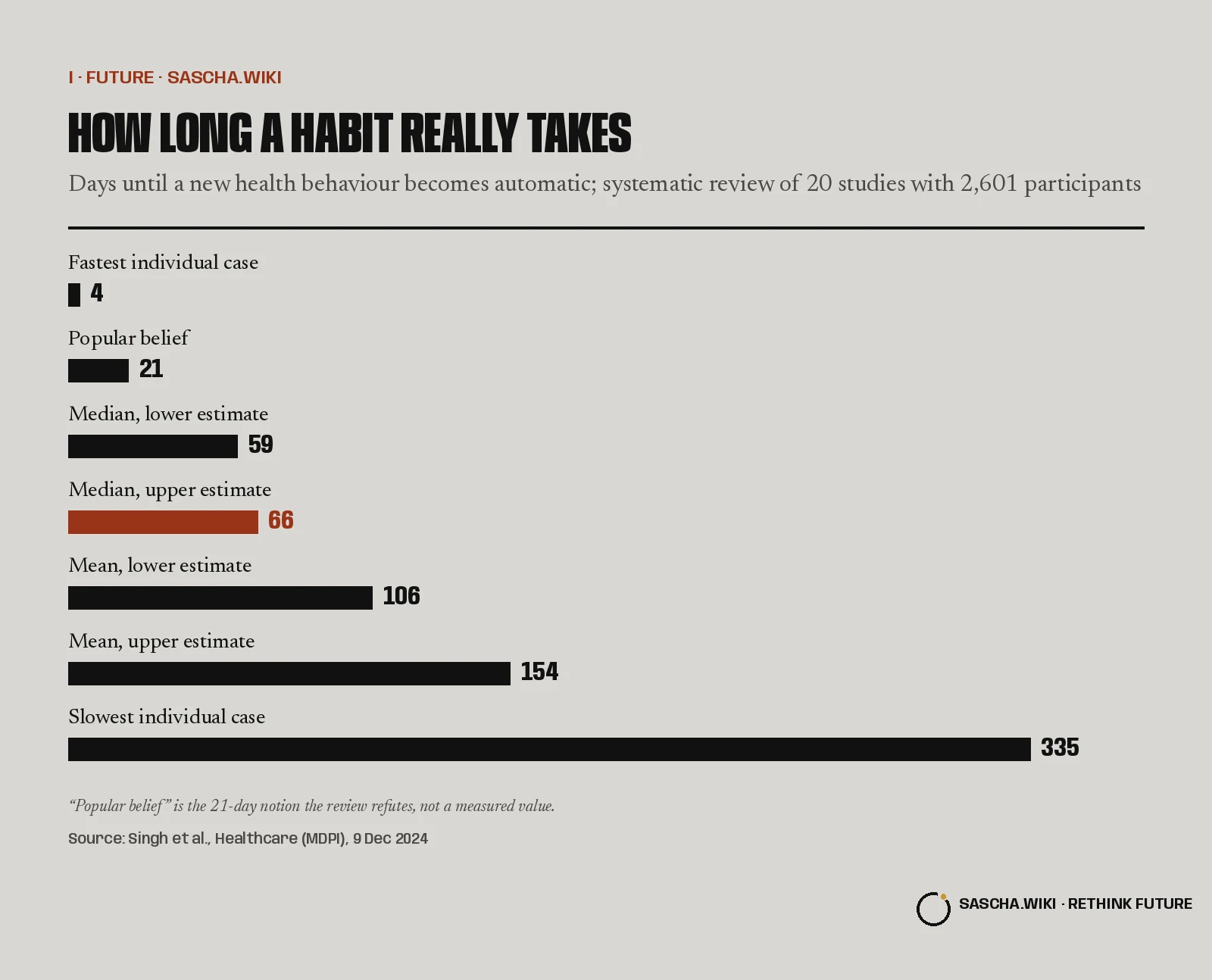
The best-known number in habit research comes from a study by Phillippa Lally and colleagues published in 2010: the median time until a new behaviour felt automatic was 66 days, with individual cases ranging from 18 to 254 days.3 A systematic review published in December 2024 by researchers at the University of South Australia pooled 20 studies with 2,601 participants. It found median times of 59 to 66 days, mean times of 106 to 154 days and a range from 4 to 335 days, and concluded that the popular notion of a 21-day habit is clearly refuted.3
The same work points to what helps: repetition, doing the new thing in the morning, enjoying it, planning it, and cues in one’s surroundings, such as laying out gym clothes the night before.4 None of this is heroic. All of it is small.
The arithmetic that follows is sobering. At around 66 days per habit, a year has room for five and a half new ones, taken strictly one after another. Twelve therefore only works if the decisions are small enough to run side by side, or if one accepts that some of them will not survive February, which is also a finding.
A decision is phrased in the present tense and needs only a Tuesday.
Twelve decisions, not twelve vows
Picture someone who resolves nothing in January and instead makes twelve small decisions over the year, roughly one a month, each attached to something that already happens. The mornings get four of them: a glass of water before the coffee, shoes placed by the door the evening before, ten minutes outside before the first screen, a single page written before the first email.
Attention gets four more: the phone charges overnight in the kitchen, the news is read once a day at a fixed hour, one photograph is taken deliberately each day rather than twenty by reflex, and ten pages of a book are read before sleep. Photography, one of my two passions alongside writing, teaches the same lesson in miniature: a good picture is rarely one big decision, more often a dozen small ones about light, distance and patience.
The last four concern other people and one’s future self: one phone call a week to someone who would otherwise receive a message, one meal cooked for more people than strictly necessary, a standing order to a savings account on payday, and one weekend hour with nothing planned in it. None of these would impress anyone at the gym on the first Monday in January. That is rather the point.
The decision that stops being one
The difference between a resolution and a decision is grammatical. A resolution is phrased in the future tense and addressed to a better version of oneself, who rarely turns up. A decision is phrased in the present tense and needs only a Tuesday.
After two months or so of daily repetition, if the research is right, a small decision turns into something else: it stops asking for willpower and starts running on its own. Twelve of those will not make anyone a new person. They may, however, make the old one noticeably easier to live with.
Sources
- DAK-Gesundheit (Forsa survey): Gute Vorsätze: Bei jungen Menschen im Trend, 2025-12-29
- YouGov: What are Americans’ New Year’s resolutions for 2026? (Jamie Ballard), 2025-12-23
- Healthcare (MDPI): Time to Form a Habit: A Systematic Review and Meta-Analysis of Health Behaviour Habit Formation and Its Determinants (Singh, Murphy, Maher, Smith), 2024-12-09
- University of South Australia via ScienceDaily: Myth busted: Healthy habits take longer than 21 days to set in, 2025-01-24