
Listen
Soundtrack to the essay · Pay Yourself First, Even With Little
The Box Already Ticked
Melodic techno, steady and dry: a sixteenth-note arp, metronomic hats, a touch of tape saturation.
Intro
Six a.m., the salary lands
Verse
By nine the rent, the phone, the gym nobody visits
Saving is whatever survives the month
Drop
Pay yourself first, before the month can vote
The box already ticked
Verse
One in a hundred when they had to choose
Nearly half when nobody had to decide
A calendar keeps promises better than we do
Drop
Pay yourself first, before the month can vote
The box already ticked
Outro
It moves the money that is there, not the money that is not
Music and vocals are AI-generated; the lyrics draw on the essay. The EBM version is instrumental. All twelve pieces: Rethink Future 2027.
Picture the first working day of the month. The salary lands at 6 a.m.; by nine, rent, phone contract, insurance and the gym nobody visits have taken their share. What remains is called, optimistically, disposable income, and saving is whatever survives until the thirtieth. Usually nothing survives. This is not a flaw of character. It is an order of operations.
“Pay yourself first” reverses the order: a small sum leaves the account on payday, before the month has a chance to vote. The idea is old, and in its usual telling slightly smug. The evidence behind it is neither.
The box already ticked
Anyone who has worked in direct marketing, as I did for Microsoft, Quelle and Condé Nast, learns one unglamorous truth early: the box that is already ticked wins. People rarely object to a default. They simply never get round to changing it. Behavioural economists call this inertia. Marketers call it Tuesday.
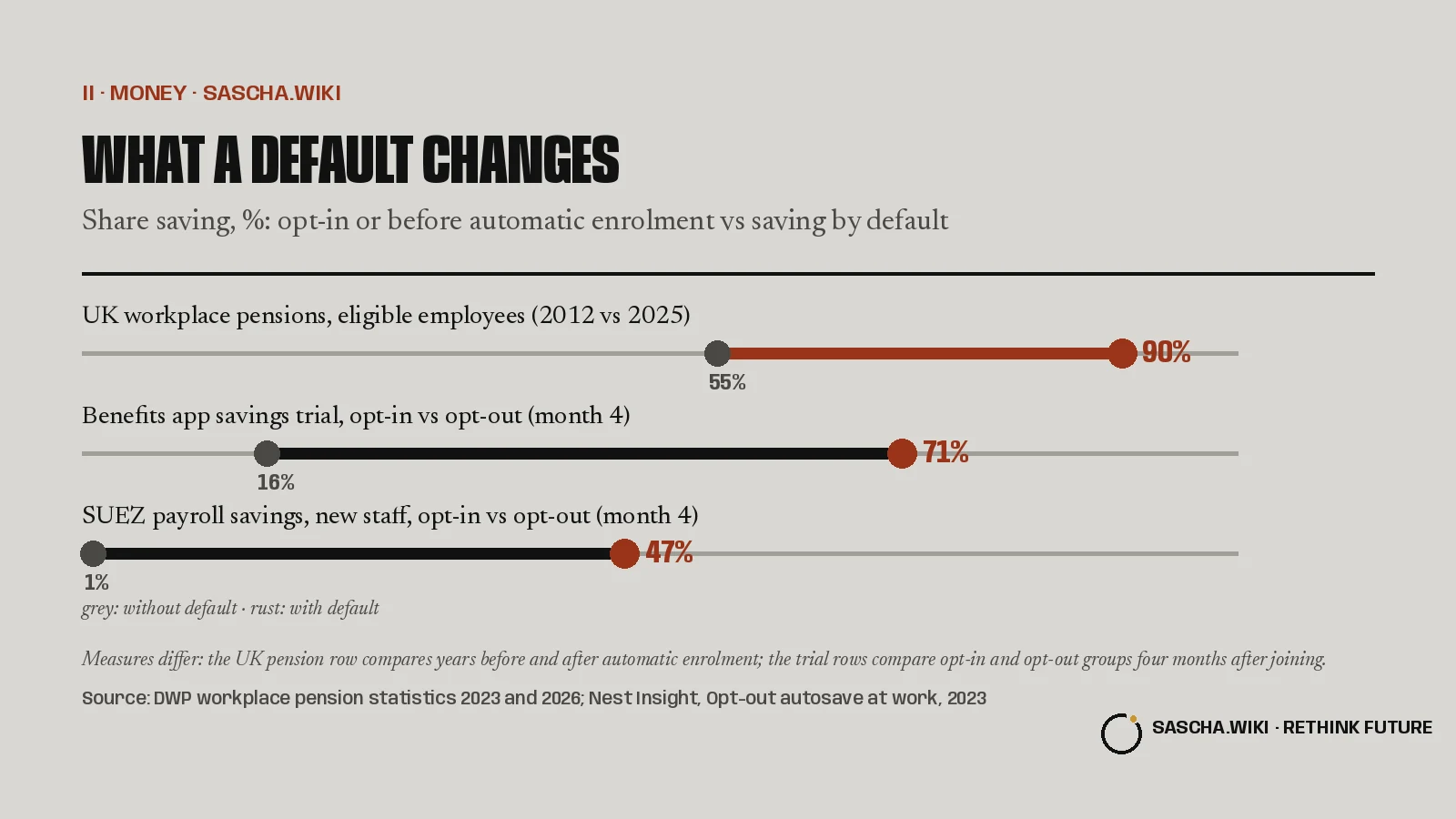
Britain turned that truth into social policy. Since 2012, employers have had to enrol eligible staff into a workplace pension automatically; staying in requires nothing, leaving requires a form. In 2012, 55% of eligible employees were saving into a workplace pension.1 By 2025 the figure was 90%, some 22.6 million people.2 No sermon on thrift has ever achieved that. A changed default did.
The principle is so plain that it is easy to underrate. The person does not change; only the route the money takes. A standing order on payday saves not with discipline but with a calendar, which is fortunate, because calendars are considerably more reliable than people.
Small, automatic, withdrawable
The same logic works over months rather than decades. In a trial run by Nest Insight at the waste management company SUEZ, new staff were offered a savings account paid straight from their salary, in one of two ways. When they had to sign up, 1% saved. When saving was switched on and they were free to opt out, 47% were saving four months later. In a second trial, run through a workplace benefits app, participation rose from 16% to 71%.3 The only thing that changed was who had to make the decision.
The detail that interests me most is a different one: 29% of the SUEZ opt-out savers had already taken money out.3 That is not failure. It is the point. A pension is for the person you will be at seventy; a buffer is for the person lying awake next Tuesday. The Federal Reserve reported in May 2026 that 55% of American adults had set aside three months of expenses in an emergency or rainy day fund.4 In the Netherlands, the organisers of the savings campaign “Betaal jezelf eerst” report that one household in five has less than 1,000 euros in reserve, and that 9% of participants in their own test became more willing to set up automatic saving after reading a few well chosen messages.5 Nine percent is modest. It is also nine percent more than a lecture has ever produced.
A default can move money that exists. It cannot create money that does not.
Where the advice runs out
And here an honest writer has to stop. The same Federal Reserve data show the three-month buffer at 75% among adults with family incomes of 100,000 dollars or more, and at 21% among those below 25,000 dollars.4 Britain’s automatic enrolment does not reach anyone earning under the £10,000 earnings trigger, which has been frozen for years.2 A default can move money that exists. It cannot create money that does not.
This is why the latte sermon deserves a quiet retirement. The notion that people on low incomes are one skipped cappuccino away from security has survived every recession, though rarely the arithmetic. For a household that runs short at the end of every month, the problem is wages, rent and prices, not willpower, and the respectful answer lies with employers and governments: pay, benefits, payroll schemes that seed a buffer rather than merely invite one. Paying yourself first assumes there is something to pay.
Still, where there is a little room, the smallest automatic sum does something beyond its size. It turns saving from a monthly decision into a standing fact, and it gives the 3 a.m. mind something to hold on to. Not a fortune. A floor.
Sources
- Department for Work and Pensions (UK): Workplace pension participation and savings trends of eligible employees: 2009 to 2022, 2023-11-22
- Department for Work and Pensions (UK): Workplace pension participation and savings trends of employees: 2009 to 2025, 2026-07-30
- Nest Insight: Opt-out autosave at work: a popular and proven way to powerfully boost people’s saving, September 2023
- Board of Governors of the Federal Reserve System: Economic Well-Being of U.S. Households in 2025: Savings and Investments, May 2026
- Stichting Financieel Gezond Nederland (SFGN): 44% van de huishoudens financieel kwetsbaar: Koningin Máxima bij lancering nationale spaarcampagne, 2026-04-23