
Listen
Picture a meeting room in The Hague in January 2030. Someone has brought the latest survey, someone else has brought the coffee, and pinned to the wall is the financial health target set years earlier: by 2030, the number of households that are financially unhealthy will have been halved. The meeting will be either mildly celebratory or mildly awkward. What it can no longer be is vague.
That room holds the whole difference between a concern and a policy. Financial health becomes political only once it has a target with a date. Until then it remains a sentiment, however well researched.
From access to health
On 25 September 2024 the United Nations changed a job description. Queen Máxima of the Netherlands, for fifteen years the Secretary-General’s Special Advocate for inclusive finance, received a new mandate as Special Advocate for Financial Health.1 The shift sounds technical. It is not. Inclusion asks whether people have an account. Health asks whether they can get through the month, absorb a shock, plan ahead and feel reasonably confident about all three; those are the four elements of the definition her office uses.2 The same office calls on political leaders, regulators and the private sector to commit.
Commit to what, precisely, is the part a mandate cannot answer. A definition tells you where to look. It does not tell you how much of the problem you want gone, or by when.
The country with a deadline
The Netherlands has answered both questions. A national coalition of public and private organisations, employers among them, which the financial regulator AFM joined in February 2025, has set itself the goal of halving by 2030 the number of households that are financially inadequate or unhealthy.3 The UN office’s 2025 annual report cites the coalition as an example.4 Queen Máxima is honorary chair of the Netherlands Financial Health Foundation, in which 55 public and private partners now work together.5
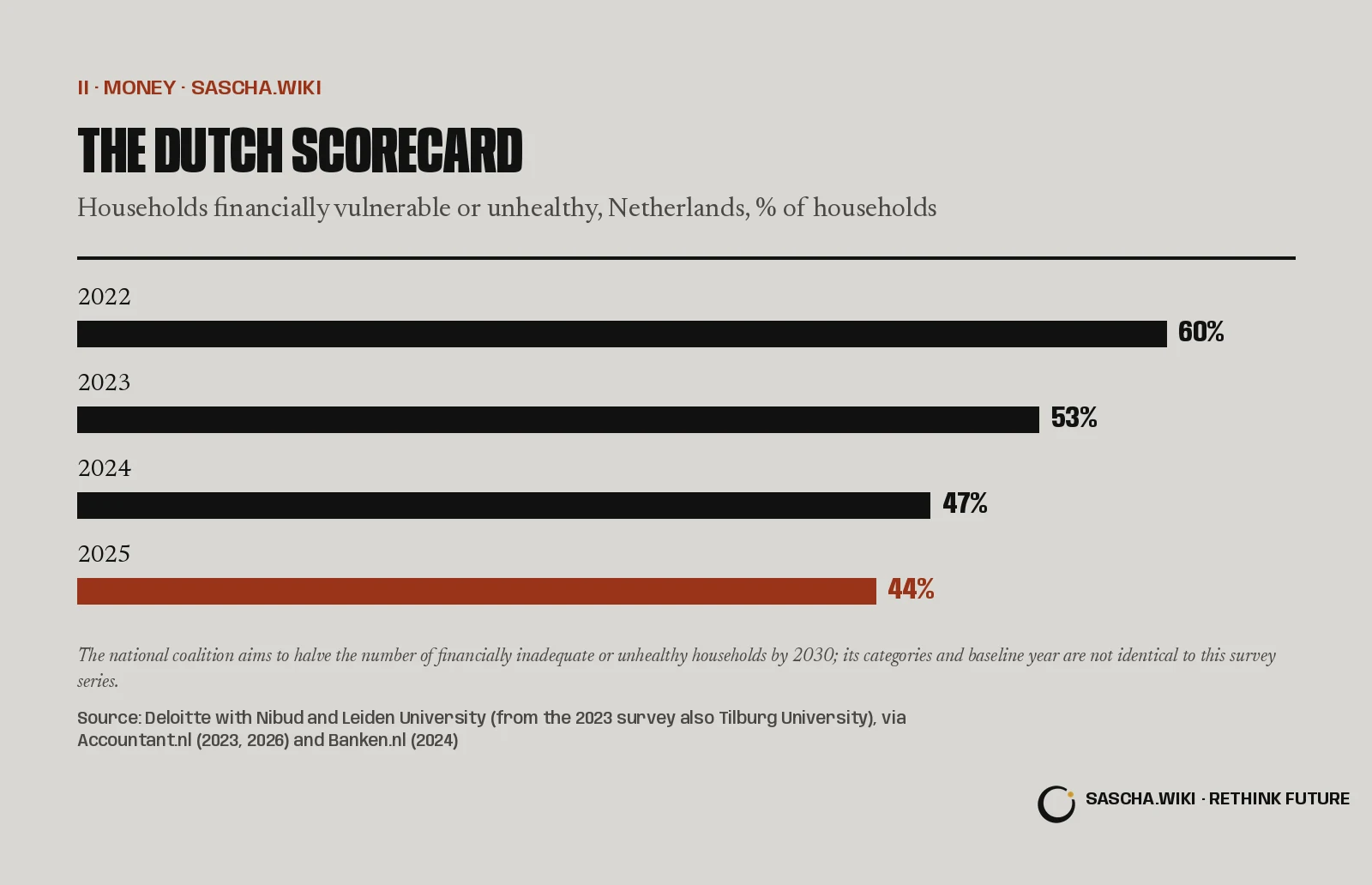
What makes the Dutch case instructive is less the ambition than the trajectory, because a target turns an annual survey into a scorecard. The measurement by Deloitte, the budget institute Nibud and researchers from Leiden and, later, Tilburg found 60% of households financially vulnerable or unhealthy in 2022,6 53% in 2023,7 47% in 2024 and 44% in 2025.8 Forty-four per cent is still a great many kitchen tables. But each of those figures now answers a question that was asked in advance: are we closer?
Anyone who has worked in direct marketing, as I have, knows that a campaign without a response target cannot fail. That is precisely why it cannot succeed either.
A target nobody sets can never be missed, which may be its chief administrative appeal.
Three countries that count
The United States measures financial health with admirable rigour, although the measuring is done by a non-profit, the Financial Health Network, rather than by a ministry. Only 31% of American households were financially healthy in spring 2025.9 A year later the share of financially vulnerable households had risen from 15% to 17%.10 The numbers arrive every autumn, are reported like the weather and are treated in much the same way.
Japan offers the mirror image. In November 2022 its government adopted a plan to double household asset income.11 It came with numbers and a deadline: by the end of 2027, twice as many tax-free NISA investment accounts, 34 million instead of 17 million, and twice as much money bought through them, 56 trillion yen instead of 28 trillion.12 By December 2025 purchases had reached 71.4 trillion yen, well past the goal, and accounts stood at 28.2 million.12 Targets work, then. They also work on whatever they are aimed at, and Japan aimed at investment accounts, not at households that can survive a bad month.
Germany counts carefully too. Creditreform’s SchuldnerAtlas put the number of over-indebted adults at around 5.67 million in November 2025.13 Figures of this kind are published, quoted, regretted and filed. They are compared with last year, never with a goal, because I have found no German government that has set one. In May 2026 the Börsen-Zeitung, not a paper given to sentiment, concluded that some of the Dutch approach could surely be copied in Germany, with one exception: Queen Máxima’s decisive part in establishing the foundation; Germany would need another public figure.14 A target nobody sets can never be missed, which may be its chief administrative appeal.
What a date does
A date is an unglamorous instrument. It raises no wage and lowers no rent. What it does is assign embarrassment in advance. Somebody will have to stand in that room in 2030 and explain the figure, and knowing this changes behaviour long before 2030 arrives: which data are collected, which partners are invited to the table, which debt collection practices suddenly look expensive.
That is the real lesson of the UN mandate, and it is not addressed to the Netherlands, which has already drawn it. It is addressed to Berlin, Washington and Tokyo. All three measure financial distress. None of them has yet written down, as the Dutch have, how much less of it they want, and by when.
A little over three years remain. The Dutch may well miss their mark; halving is hard, and the easy gains may already have been made. Even then they will know precisely how far they got, and why. Everyone else will have another autumn report, another set of regrettable percentages and a calendar on which no page has been marked.
Sources
- UNSGSA: UN Event Marks 15 Years of Financial Inclusion and New Financial Health Mandate for the UNSGSA, 2024-09-27
- UNSGSA: Financial Health, undated web page, accessed 2026-09-30
- Banken.nl: AFM sluit zich aan bij Nationale Coalitie Financiële Gezondheid, 2025-02-14
- UNSGSA: UNSGSA 2025 Annual Report to the UN Secretary-General, 2025-09-26
- Rijksoverheid: Koningin Máxima en minister Vijlbrief op werkbezoek in Amsterdam Zuidoost, 2026-07-06
- Accountant.nl (Deloitte study): Deloitte-onderzoek: Financiën staan bij zes op de tien huishoudens onder druk, 2023-03-07
- Banken.nl (Deloitte study): Meer financiële lucht voor Nederlandse huishoudens, maar nood blijft hoog, 2024-03-28
- Accountant.nl (Deloitte with Nibud, Tilburg University and Leiden University): Financiële gezondheid Nederland verbetert, maar veel huishoudens nog financieel kwetsbaar, 2026-04-28
- Financial Health Network: Financial Health Pulse 2025 U.S. Trends Report, 2025-09-17
- The Philadelphia Inquirer / The New York Times (Ann Carrns), on the Financial Health Pulse 2026: More U.S. households are struggling financially, analysis finds, 2026-09-21
- Mitsubishi UFJ Asset Management: Market report on the Doubling Asset-Based Income Plan (decided 28 November 2022), July 2023
- Financial Services Agency of Japan (via Ministry of Finance): 令和9年度税制改正要望事項(新設・拡充・延長), 2026
- Creditreform Wirtschaftsforschung: SchuldnerAtlas Deutschland 2025, 2025-11-14
- Börsen-Zeitung: Finanzbildung auf niederländisch, 2026-05-01