Listen
Picture a savings bank branch in a German town on Friday 30 October, the day on which Germany marks World Savings Day this year.1 Children queue at the counter with their piggy banks, the coins are tipped out and counted, and every young saver leaves with a colouring book and a word of praise. It is a charming ritual, and a revealing one. Everyone in the room is congratulated on the amount. Nobody is asked how the amount makes them feel.
The day itself was invented in Milan. On 31 October 1924, 350 delegates from 27 countries gathered for the first International Thrift Congress, to promote saving as the road to financial security and independence.2 A century later the road turns out to fork. A large pile of savings is not a certificate of financial health, and Japan shows why: the accounts get opened, the money stays on deposit, and the worry comes to work.
A mountain of yen
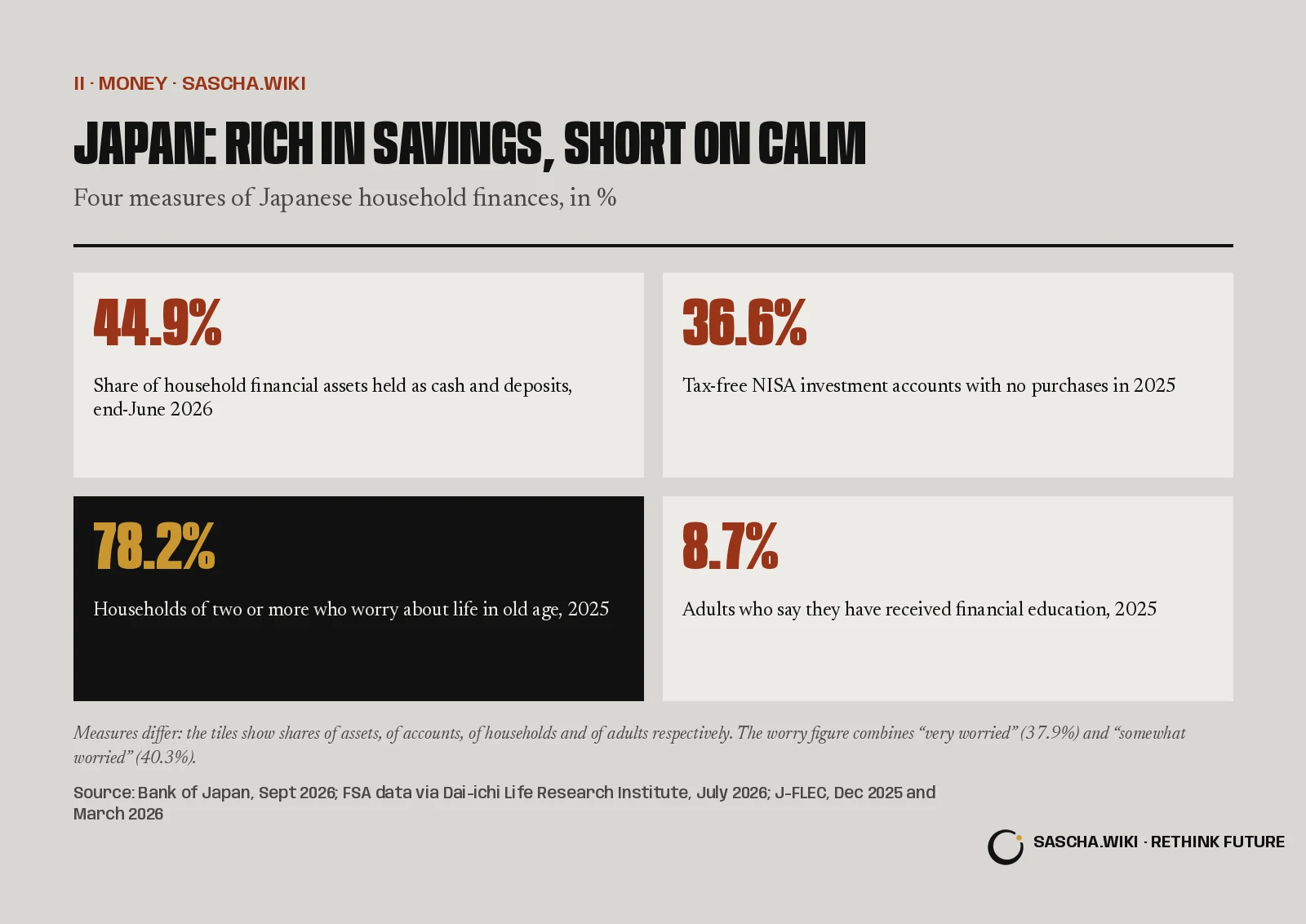
At the end of June 2026, Japanese households owned financial assets of 2,519 trillion yen. Of that, 1,132 trillion, or 44.9%, was held as cash and deposits, according to the Bank of Japan.3 Over the year the total grew by 11%, largely courtesy of the stock market; the deposits grew by half a per cent. Close to half of an enormous fortune is sitting in the waiting room.
The government has spent years trying to coax it out. By the measure politicians like best, the reformed NISA, a tax-free investment account, is a triumph: at the end of 2025 there were 28.21 million accounts, 10.2% more than a year earlier. The Dai-ichi Life Research Institute then asked the less flattering question. In 36.6% of those accounts, nothing whatsoever was bought during 2025.4 Opening an account is a decision one takes once. Using it takes a routine, and no routine, regrettably, comes with a tax exemption.
Comfortable now, uneasy later
If money bought calm, Japan would be the calmest country on earth. The surveys disagree. J-FLEC, the national body for financial education, asked households in 2025 about their old age. Among those with two or more members, 37.9% said they were very worried and another 40.3% somewhat worried: 78.2% in all.5
Nor does the worry stay at home. Nomura asked 11,145 employees of listed companies, people with some of the steadiest jobs in the country, how they felt about money. 58% described their finances at present as going well or fairly well. Only 35% felt secure about the future. And 36% said there were times during working hours when private money matters kept them from concentrating.6 They are the people with lanyards and regular payslips, looking at a comfortable present and an uneasy horizon.
Part of the explanation may be that thrift was taught as a virtue rather than as a skill. In J-FLEC’s financial literacy survey, published in March 2026, only 8.7% of respondents were aware of having had any financial education at all.7 Deposits are what money turns into when nobody has shown its owner an alternative worth trusting.
A savings rate is an average, and averages do not lie awake.
The German mirror
Germans will recognise the pattern, because they practise it. Ahead of last year’s World Savings Day, the Federal Statistical Office reported that households had saved 10.3% of their income in the first half of 2025, roughly 270 euros per person per month.8 By international standards that is diligent. Yet an Ipsos survey for ING in December 2025 found that the share of people with any savings had fallen from 71% to 64%, while 27% said they had none. Almost one German in five, the bank reports, is kept awake at night by money worries. Its headline put the paradox in four words: more savings, fewer savers.9 The pile grows while the number of people standing on it shrinks.
In this story the United States usually plays the spendthrift. In August 2026 American households saved 4.1% of their disposable income, according to the Bureau of Economic Analysis.10 The surprise is Japan. By OECD figures published by the German statistical office, Japanese households saved just 2.8% of their income in 2023, less than Americans’ 4.7%.11 The Japanese mountain was piled up over decades; today’s inflow is modest. A savings rate is an average, and averages do not lie awake.
What the piggy bank cannot tell
None of this turns saving into a vice. A cushion is the first defence against the broken washing machine and the unexpected bill, and nobody should be talked out of one. The mistake is to take the amount for the whole story. Financial health asks more than how much. It asks where the money sits, whether its owner knows what to do with it, and whether they can think about old age without a knot in the stomach. Japan answers the first question with 44.9% in deposits and more than a third of its tax-free accounts without a single purchase, the second with 8.7% and the third with 78.2%.
Picture the same counter a few years from now. The children still bring their piggy banks, because rituals are good for children. But this time someone also asks the parents a question no piggy bank can answer: if the car broke down tomorrow, how would you feel? The answer would be harder to count than coins. It would, however, measure for the first time on 30 October the thing the day was founded to protect.
Sources
- ING Deutschland: Ihre Finanzen im Oktober (Weltspartag 2026 am Freitag, 30. Oktober), 2026-09-07
- World Savings and Retail Banking Institute (WSBI), World Savings Day: History, undated web page, accessed 2026-09-30
- Bank of Japan, Research and Statistics Department: Flow of Funds for the Second Quarter of 2026 (Preliminary report), 2026-09-17
- Dai-ichi Life Research Institute (Tei Misa), based on Financial Services Agency data: 2025年のNISA利用状況を読み解く(1): NISAが普及してもなお残る「なぜ日本人は投資をしないのか?」という課題 (Reading NISA use in 2025, part 1), 2026-07-10
- J-FLEC, Japan Financial Literacy and Education Corporation (金融経済教育推進機構): 家計の金融行動に関する世論調査2025年(二人以上世帯調査) (Survey of household financial behaviour 2025, households of two or more), 2025-12-18
- Nomura Securities, Nomura Asset Building Research Center: 第5回ファイナンシャル・ウェルネス(お金の健康度)アンケート(2025年実施) (5th Financial Wellness Survey, 2025), 2025
- J-FLEC, Japan Financial Literacy and Education Corporation (金融経済教育推進機構): 金融リテラシー調査(2025年)のポイント (Financial Literacy Survey 2025: key points), 2026-03-27
- Statistisches Bundesamt (Destatis), via news aktuell / Presseportal: Sparquote in Deutschland mit 10,3 % im 1. Halbjahr 2025 leicht unter Vorjahresniveau, 2025-10-28
- ING Deutschland (ING Consumer Research, survey by Ipsos, December 2025, 1,007 respondents): Mehr Ersparnisse, weniger Sparer (ING Consumer Research Sparen 2025), 2026-03-02
- U.S. Bureau of Economic Analysis: Personal Income and Outlays, August 2026, 2026-09-30
- Statistisches Bundesamt (Destatis), via news aktuell / Presseportal, citing OECD data: Sparquote in Deutschland im internationalen Vergleich mit 10,4 % überdurchschnittlich, 2024-10-29