
Listen

Soundtrack to the essay · The Machine Told a Joke
Wrong Moment
Melodic techno, wry and cinematic: glassy digital arps against analogue warmth, tension that never resolves.
Intro
Monday, the figures landed badly
Verse
Someone asks the machine to lighten the room
Set-up, turn, a clean finish
Nobody laughs, and the one who read it grows small
Drop
The machine supplies options
We carry the consequences
Verse
It beats most of us at the punchline now
Nothing wrong with the joke, everything with the moment
Drop
The machine supplies options
We carry the consequences
Outro
When, for whom, and whether at all
Music and vocals are AI-generated; the lyrics draw on the essay. The EBM version is instrumental. All twelve pieces: Rethink Future 2027.
Picture a Monday meeting, ten minutes after the quarterly figures have landed badly. Someone, meaning well, asks a chatbot for something to lighten the mood and reads it out. The joke is good. It has a set-up, a turn and a clean finish. Nobody laughs, and for the rest of the hour the person who read it out seems slightly smaller than before. Nothing was wrong with the joke. Everything was wrong with the moment.
That scene holds the argument of this essay: machines can now produce humour on request, but judgement, the sense of when, for whom and whether at all, cannot be prompted, and that is where the human lead lies.
The joke is no longer the hard part
It is tempting to believe that humour is the last fortress of the human mind. The evidence is unkind. In a study published in PLOS ONE in July 2024, the psychologists Drew Gorenz and Norbert Schwarz gave ChatGPT 3.5 and 105 people the same comedy tasks, then had a separate group rate the results. The machine outperformed 87% of the human participants at roast jokes, and its satirical headlines were rated about as funny as those from The Onion1. The punchline, it turns out, is a pattern, and patterns are what these systems are made of.
No machine has yet told a writer that his joke was ill-judged. This is either tact or a gap in the training data.
How far the machines have actually got
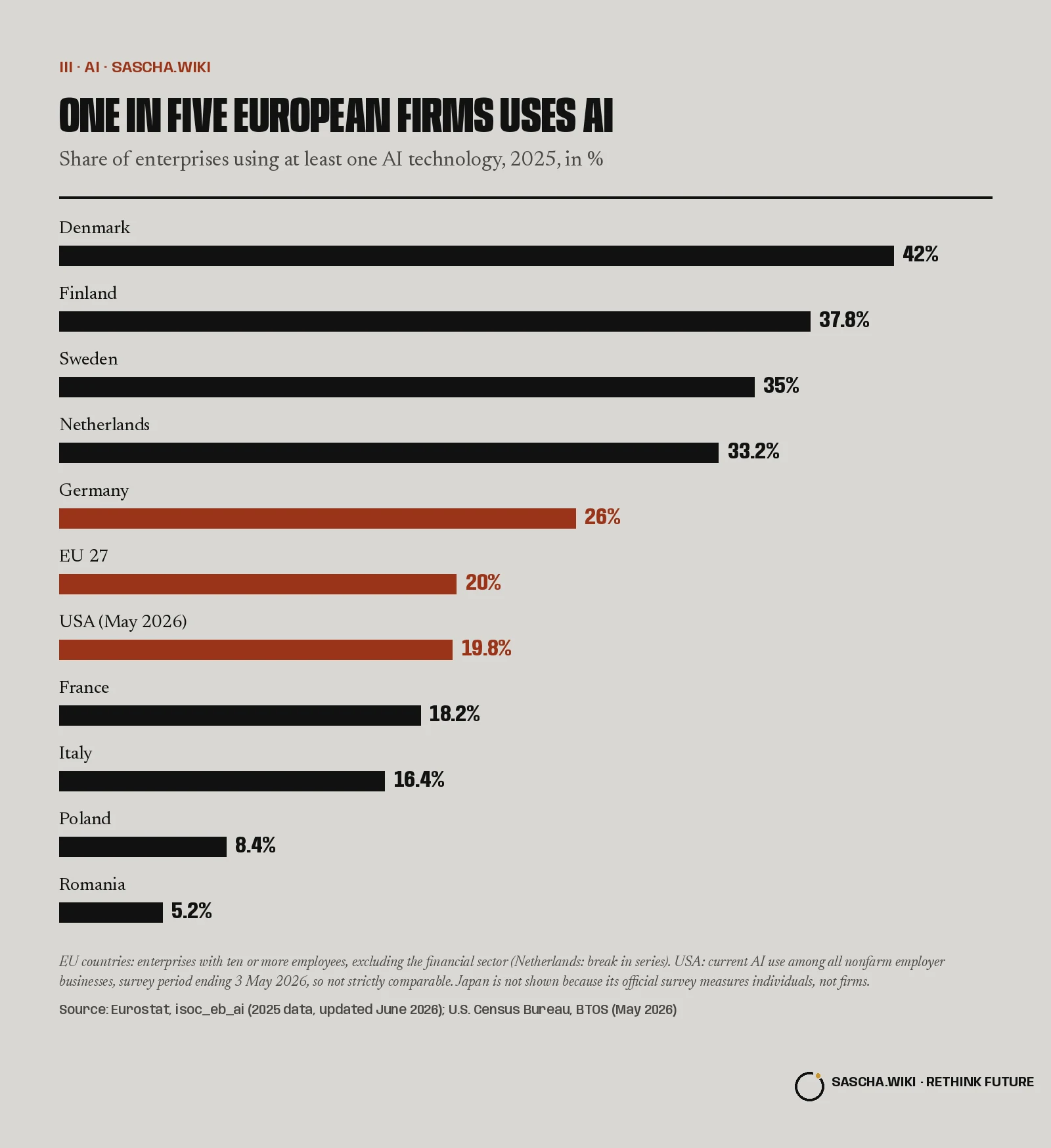
For all the noise, AI at work is still a minority habit. Eurostat reports that 20.0% of enterprises in the European Union with ten or more employees used at least one AI technology in 2025, up from 13.5% a year earlier2. The spread across the continent is wide: 42.0% in Denmark, 37.8% in Finland, 18.2% in France and 5.2% in Romania3. Germany sits above the average at 26%, and the size of the firm matters more than its postcode: 57% of German companies with 250 or more staff use AI, against 23% of those with ten to 494.
Across the Atlantic the picture is much the same. The US Census Bureau’s Business Trends and Outlook Survey put current AI use at 19.8% of American businesses in early May 2026, and at 37% among firms with 250 or more employees5. Japan measures differently, asking people rather than firms. Its Ministry of Internal Affairs and Communications found in a survey conducted in early 2026 that 58.8% of Japanese respondents had used a generative AI service, more than double the previous year’s 26.7%, although the new survey also included teenagers. The same study put the United States and Germany at 75.6% each and China at 93.6%6.
The machine supplies options, the human supplies consequences.
What people really ask for
The more revealing question is what the machines are used for. An analysis of ChatGPT conversations published by the National Bureau of Economic Research in September 2025 found that more than 70% of usage had nothing to do with work, and that practical guidance, seeking information and writing together accounted for nearly 80% of all conversations7. In European companies the most common application is the analysis of written language, used by 11.8% of all enterprises2.
The machine, in other words, is mostly a writing partner and an adviser. That is precisely the territory where tone decides everything. A sentence can be accurate and still wrong for the colleague who receives it on the day her department has been cut. The model can offer ten versions. It cannot know which of them you will still be able to defend on Thursday.
What cannot be prompted
Judgement will not arrive with the next update, because it is not really a matter of information. It is a matter of stake. The person who tells a joke in a room puts a little of their standing on the table; if it fails, they pay. The machine pays nothing, which is why it will cheerfully supply a punchline for a funeral if asked politely. Humour, done properly, is judgement with the risk left in.
I have been around computers since a school scholarship at IBM at the age of eleven, long before the internet, and they have always been good at being right. Being right at the right moment is a different profession. It involves reading faces, remembering who lost what last spring, and knowing when the funniest thing available is silence.
None of this is an argument against the tools. Let them draft, sort, summarise and, yes, suggest the joke. The sensible division of labour is easy to describe. The machine supplies options, the human supplies consequences. What the human should not hand over is the last step, the moment of deciding, because that is the only part of the work that carries a signature.
The joke from Monday’s meeting will be offered again, to someone else, in some other room. Whether it lands will depend, as it always has, on the person holding it.
Sources
- PLOS ONE (Drew Gorenz, Norbert Schwarz): How funny is ChatGPT? A comparison of human- and A.I.-produced jokes, 2024-07-03
- Eurostat: 20% of EU enterprises use AI technologies, 2025-12-11
- Eurostat: Artificial intelligence by size class of enterprise (dataset isoc_eb_ai), enterprises with 10 or more employees, 2025, 2026-06-15
- Statistisches Bundesamt (Destatis): Unternehmen mit Nutzung von Technologien der künstlichen Intelligenz nach Beschäftigtengrößenklassen, 2025-11-24
- U.S. Census Bureau: Large Firms With at Least 20 Employees Biggest AI Users (Business Trends and Outlook Survey), 2026-05-26
- Ministry of Internal Affairs and Communications, Japan (総務省): 令和8年版情報通信白書(概要) (White Paper on Information and Communications in Japan 2026, summary), July 2026
- National Bureau of Economic Research: How People Use ChatGPT (Working Paper 34255), September 2025