Listen
A wallet lies on a bench outside a railway station, in some town or other. Inside: a few notes, an identity card, a phone number. Ask passers-by how likely it is that a stranger will bring it back and they answer cautiously, in every country where the question has been put. Leave the wallet there for real and it comes back roughly twice as often as the people asked had expected113. That, in one sentence, is the finding of the World Happiness Report 2025: we think worse of others than they deserve, and we are happier where we experience the opposite.
The finding has a political point that is not aimed at politics. Happiness is in no coalition agreement, not because governments do not want it, but because it is not made there. It is made at the table, on the square, on the train, at the end of the month when the sums work out. This essay opens a series that looks exactly there. The thesis: politics sets the frame, happiness is experienced elsewhere, and in that elsewhere companies have a larger share than their balance sheets suggest.
Ministers for happiness
It is not for want of trying. Bhutan has measured gross national happiness since the 1970s. The United Arab Emirates appointed a minister of state for happiness in February 20162. Britain got a minister for loneliness in January 20183. New Zealand presented the first Wellbeing Budget in May 2019, a national budget arranged by wellbeing rather than by ministry4. Germany asked 15,750 citizens at 203 events what makes people happy and what matters to them, and in October 2016 the cabinet adopted a report called “Gut leben in Deutschland”, good living in Germany, with twelve dimensions and 46 indicators5. All of this is honourable, and none of it is wrong. It is simply not where happiness happens.
The league table, at any rate, barely moves. In the World Happiness Report 2026 Finland is first for the ninth year running, followed by Iceland, Denmark and Costa Rica, the highest ranking a Latin American country has ever reached. Germany is 17th, the United States 23rd614. What the top has in common the report has explained for years with six variables: income, healthy life expectancy, social support, freedom to make life choices, generosity and perceived corruption1. Income, health and clean institutions are the state’s business. Support, freedom and generosity are made between people, in flats, in workplaces, on the street. A government can protect them. It cannot manufacture them.
Where happiness is made
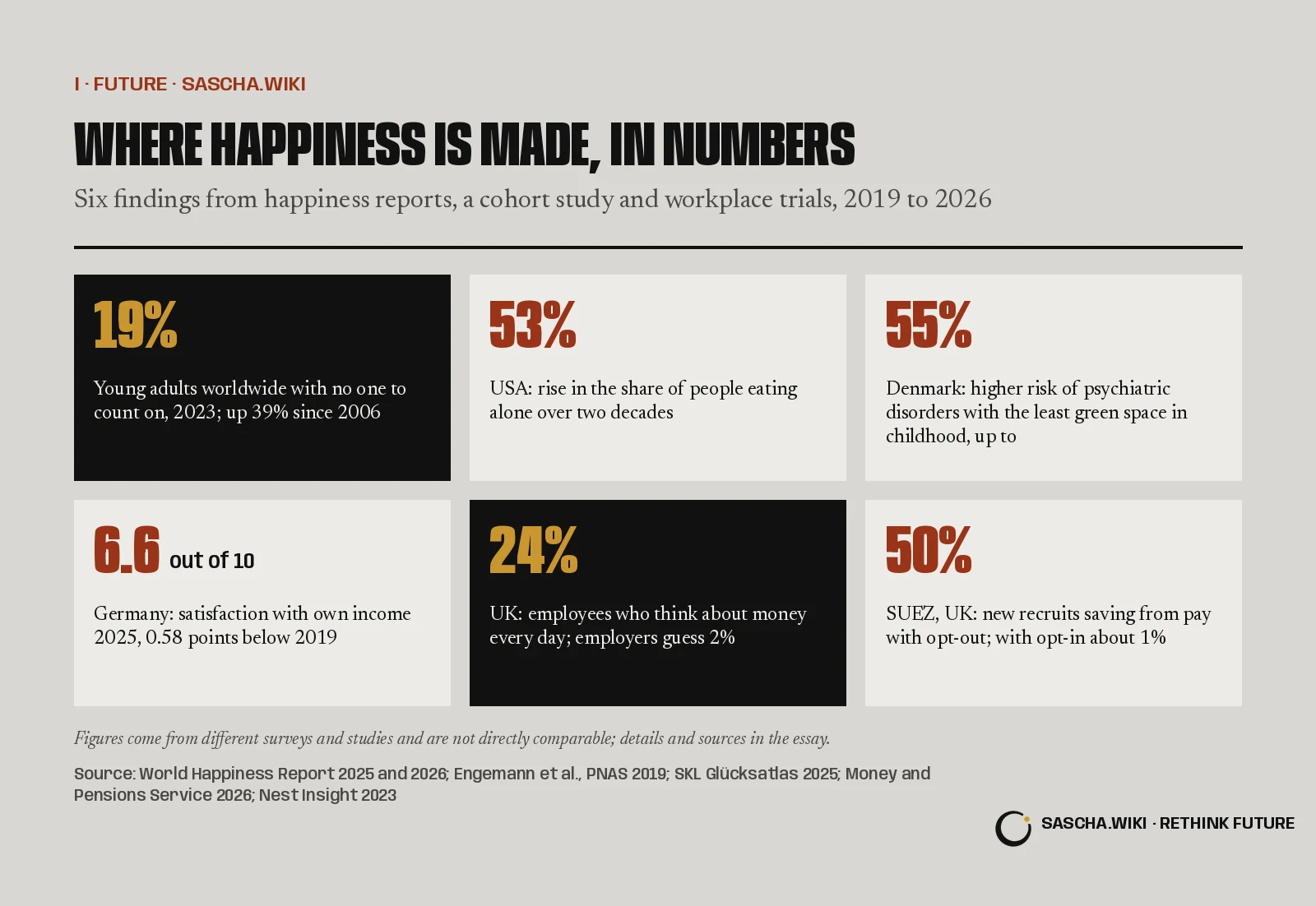
The 2025 report was titled “Caring and Sharing”, and it read like the counter-programme to any ministry. People who regularly eat with others rate their lives better, in every region of the world, and the link is of the same order as the effects of income and unemployment. In the United States the share of people who eat alone has risen by 53% in two decades. Households of four or five are the happiest in Europe and Mexico. And in 2023, 19% of young adults worldwide said they had no one they could count on, a rise of 39% since 20061. Deaths of despair are rarer where people help one another more often1.
The 2026 report continues the line with a different subject: social media. Perceived social activity has fallen everywhere and is among the strongest explanations for where wellbeing has been lost. Teenagers who spend more than seven hours a day on social media rate their lives markedly lower than those who spend less than an hour; for girls in Western Europe almost a full point is missing on the scale from zero to ten. But the most striking number stands next to it: when a sense of belonging at school rises from low to high, girls in the United Kingdom and Ireland gain four times as much life satisfaction as they would if their social media use fell from high to low6. The screen does not decide. Whether someone belongs does.
Belonging has a place, and the place can be measured. A Danish study followed almost a million people from birth and read the satellite images of their childhoods, year by year, house by house. Those with the least green around their homes in the first ten years of life carried a risk up to 55% higher of developing a psychiatric disorder later, and the risk fell with the amount and the duration of the green7. Parks, courtyards, trees along the street, the bench outside the station: that is not decoration. It is infrastructure, the kind on which the sharing in the happiness report takes place. The next essay in this series is about it.
Happiness is in no coalition agreement, not because governments do not want it, but because it is not made there.
The second pillar: money
And then there is the worry hardly anyone talks about. The SKL Glücksatlas 2025 puts life satisfaction in Germany at 7.09 out of ten, almost unchanged on the year. Satisfaction with one’s own income, however, stands at 6.60, 0.58 points below its 2019 level8. Life is fine; the money is not. British employers estimate that 2% of their staff think about money every day; the staff themselves say 24%9. In Japan, 36% of employees of listed companies know spells at work when private money questions stop them concentrating10.
That worry is the second place where happiness is made or lost. It appears in no index as a line of its own, but it eats the other lines: whoever does sums at night invites nobody to dinner, does not go to the square, does not trust the stranger who brings the wallet back. Caring about money is therefore not social policy to be left to others. It is the condition for the other variables to work at all.
What a company can do tomorrow
This is where companies come in, not as the accused, but as the institution that manages more of people’s waking hours than any government. Three things can begin tomorrow, without a resolution and without a budget line.
First, the table. A shared lunch at a fixed time, with no agenda, is the cheapest measure the World Happiness Report has ever suggested. Second, the rainy-day fund. In Britain, employers such as SUEZ, the Co-op and Bupa introduced payroll savings accounts in which everyone is enrolled automatically and can opt out at any time. With opt-in, around 1% of the workforce had been saving; with opt-out, about half of SUEZ’s new recruits took part, and around 70% of new users at the Co-op and Bupa, with no harm to pension saving1112. Third, the room. Whoever moves the lunch break outdoors instead of to the desk, holds the team meeting in the library round the corner, or lets Friday afternoon go, shifts working time into the public space where happiness demonstrably is made.
None of this is charity. It is the recognition that the three variables a government cannot manufacture, support, freedom and generosity, are produced or destroyed in workplaces every day, together with the trust that carries them. A company that tends them does not buy dependence. It buys loyalty. That is the bet of this almanac, and this essay is its first stake.
The wallet on the bench, by the way, comes back more often than we believe, and most often where people are convinced that someone cares about them. That is not a question of majorities. It is a question of who looks.
Sources
- Helliwell, J. F., Layard, R., Sachs, J. D., De Neve, J.-E., Aknin, L. B., Wang, S. (eds.), Wellbeing Research Centre, University of Oxford: World Happiness Report 2025: Caring and Sharing (wallet experiments, six explanatory factors, sharing meals, household size, 19% of young adults with no one to count on, deaths of despair), 2025-03-20
- United Arab Emirates Government (u.ae): Happiness: appointment of a Minister of State for Happiness in February 2016, undated web page, accessed 2026-10-01
- UK Government, Prime Minister’s Office: PM commits to government-wide drive to tackle loneliness (appointment of a Minister for Loneliness), 2018-01-17
- New Zealand Treasury: The Wellbeing Budget 2019, 2019-05-30
- Bundesregierung (Federal Government of Germany): Gut leben in Deutschland: Regierungsbericht zur Lebensqualität in Deutschland (12 dimensions, 46 indicators; 15,750 participants in 203 dialogue events; adopted by the cabinet on 26 October 2016), 2016-10-26
- Helliwell, J. F., Layard, R., Sachs, J. D., De Neve, J.-E., Aknin, L. B., Wang, S. (eds.), Wellbeing Research Centre, University of Oxford: World Happiness Report 2026: Executive summary, happiness and social media (rankings; perceived social activity; seven hours and more of social media; school belonging four times stronger), 2026-03-18
- Engemann, K., Pedersen, C. B., Arge, L., Tsirogiannis, C., Mortensen, P. B., Svenning, J.-C., Proceedings of the National Academy of Sciences (PNAS), vol. 116, no. 11, pp. 5188 to 5193: Residential green space in childhood is associated with lower risk of psychiatric disorders from adolescence into adulthood (Denmark, about 950,000 people born 1985 to 2003; up to 55% higher risk with the least green space), 2019-02-25
- SKL Glücksatlas 2025 (Universität Freiburg, Bernd Raffelhüschen; 13,905 respondents, July 2024 to June 2025): SKL Glücksatlas 2025: Lebenszufriedenheit 7,09, Einkommenszufriedenheit 6,60 (minus 0,58 gegenüber 2019), 2025-10-27
- Money and Pensions Service (UK): Essential Guide for Employers 2026: Financial wellbeing in the workplace (employers estimate 2% of staff think about money every day; 24% of employees say they do), 2026
- Nomura Securities, Nomura Asset Building Research Center: 第5回ファイナンシャル・ウェルネス(お金の健康度)アンケート(2025年実施) (5th Financial Wellness Survey, 2025; 11,145 employees of listed companies; 36% cannot concentrate at times because of private money matters), 2025
- Nest Insight: Opt-out autosave at work: findings from real-world trials with SUEZ, Co-op and Bupa (participation around 50 percentage points higher than with opt-in; about half of new SUEZ recruits, about 70% of new benefits-app users at Co-op and Bupa), 2023-09-19
- Pensions Age, reporting Nest Insight’s preliminary findings: Autosave emergency savings trial “very encouraging”; no impact on pension saving (53% participation with opt-out against 1% with opt-in at SUEZ), 2022-09-07
- University of Oxford, news: World Happiness Report 2025 shows people are much kinder than we expect (wallet return around twice as high as expected; Americans dining alone up 53% in two decades), 2025-03-20
- IamExpat Germany: Germany moves up five spots in World Happiness Report (17th in 2026 after 22nd in 2025), 2026-03-20