
Listen
Soundtrack to the essay · Money Is a Feeling
Three A.M. Arithmetic
Melodic techno, nocturnal and restless: arpeggios, rolling bass, a clock as percussion.
Intro
Three a.m., the kettle still cold
Verse
A phone lights a tired face in the kitchen
The balance never quite loads
Nothing has moved since evening, still we count
Drop
Money is a feeling
It is whether you can sleep
Verse
One broken boiler, one dentist away
A third of a rich country awake with me
Drop
Money is a feeling
It is whether you can sleep
Outro
Thirty days to find it, thirty days
Music and vocals are AI-generated; the lyrics draw on the essay. The EBM version is instrumental. All twelve pieces: Rethink Future 2027.
Money worries keep unsociable hours. By day they queue politely behind meetings, school runs and the weather. At 3 a.m. they have the house to themselves. Picture a kitchen in any European city at that hour: the kettle still cold, a phone lighting a tired face, a banking app opened and closed again before the balance has quite loaded. Nothing has happened since the evening. No letter has arrived. And yet the sums are being done once more, as if the numbers might have moved while everyone slept.
This is the part of money that no balance sheet records. Economists measure income, assets and debt, and they are right to. But the question people put to themselves in the dark is simpler and harder: if something went wrong tomorrow, would I cope? Financial health is not a sum. It is whether you can sleep.
A map drawn in pressure
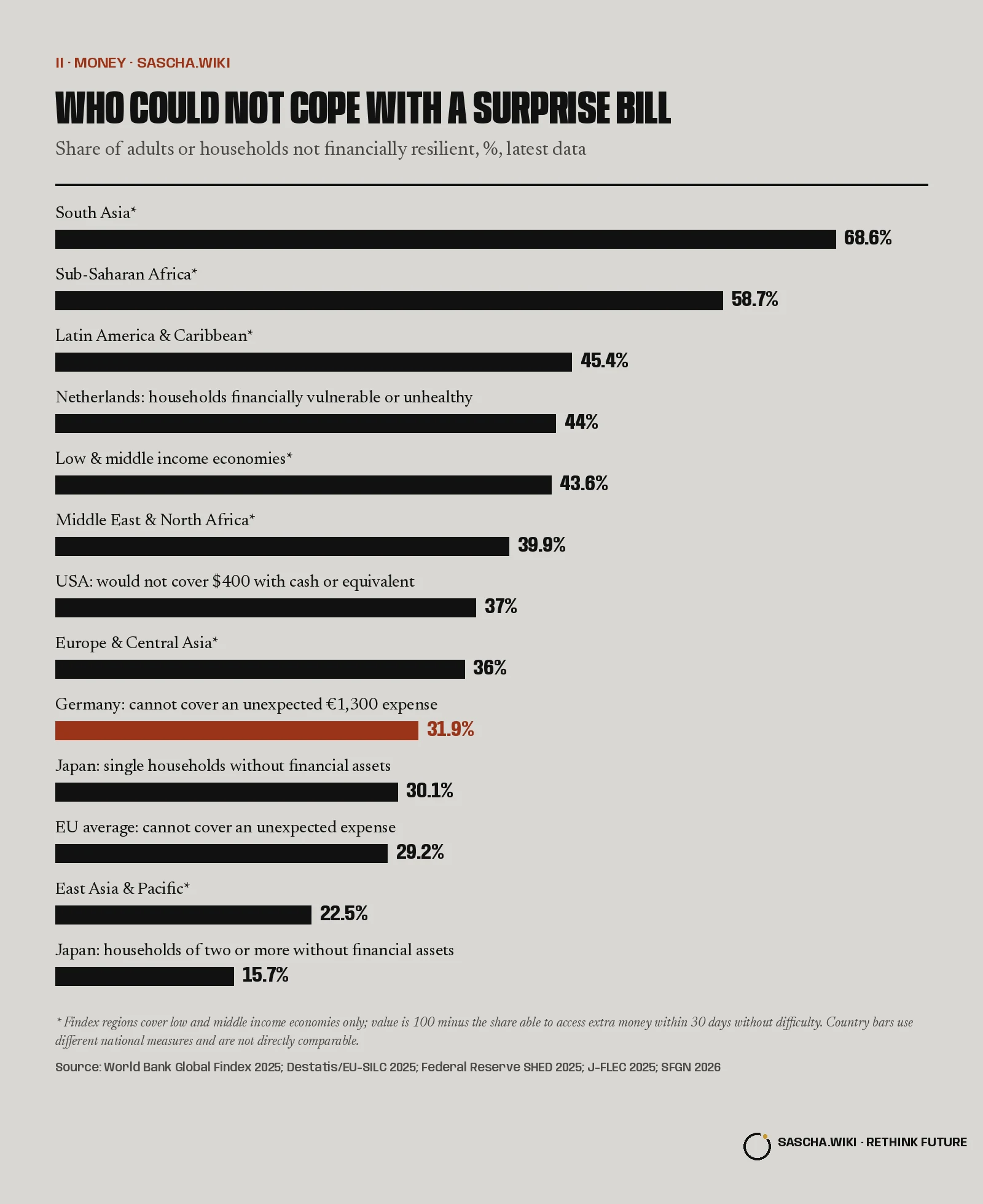
The World Bank has begun, usefully, to ask the night-time question at scale. Its Global Findex 2025 counts an adult as financially resilient if extra money for an emergency could be found within 30 days without difficulty. Across low and middle income economies, 56% say it could.1 Turned round, more than four adults in ten could not, and for them a broken motorbike or a hospital bill is not an inconvenience but an event.
The regional figures, which cover developing economies only, read like a map drawn in pressure rather than borders.2 In East Asia and the Pacific, 77.5% of adults could raise emergency money; in Europe and Central Asia, 64.0%; in the Middle East and North Africa, 60.1%; in Latin America and the Caribbean, 54.6%. In Sub-Saharan Africa the share falls to 41.3%, and in South Asia to 31.4%. There, more than two adults in three would struggle to find emergency money within a month.
Rich countries, same hour
Wealth does not cancel the 3 a.m. shift; it merely changes the amounts. In Germany, 31.9% of the population lived in 2025 in households that could not pay an unexpected bill of 1,300 euros from their own funds, according to EU-SILC results published by Destatis on 11 May 2026.3 The EU average was 29.2%.4 The nation that sells precision to the world, it turns out, has almost a third of its people one broken boiler and one dentist away from real trouble.
In the United States, the Federal Reserve’s annual household survey, published in May 2026, offers a telling pair of numbers. 73% of adults said they were doing at least okay financially. Only 63% would cover a 400 dollar emergency with cash or its equivalent.5 The gap between those two figures is, roughly, where the sleepless live: people who feel fine by day and do the maths by night.
Japan, a country with a reputation for thrift, has its own quiet version. In the 2025 household survey by J-FLEC, the national financial education body, 30.1% of single-person households and 15.7% of households with two or more people reported holding no financial assets at all.6 The measures differ from country to country, so these numbers are cousins rather than twins. But they rhyme.
Financial health is not a sum. It is whether you can sleep.
Saying the number out loud
The Netherlands has chosen to treat the matter as a public conversation. On 23 April 2026, a national savings campaign called “Betaal jezelf eerst” (pay yourself first) was launched at the Ministry of Finance in the presence of Queen Máxima, who is honorary chair of Wijzer in geldzaken and of the foundation Financieel Gezond Nederland. The organisers cite annual research by Deloitte, Nibud and the universities of Tilburg and Leiden: 44% of Dutch households are financially vulnerable or unhealthy.7
What interests me is less the slogan than the setting. A campaign launched in a ministry says, in effect, that money worry is not a private failing to be dealt with in the dark. It is a condition shared by millions, and it can be discussed at lunchtime.
Talking about money takes away part of its power. Not all of it: a conversation has never paid the rent. But the 3 a.m. version of a problem is always larger than the daylight one, because at night it has no edges. Said aloud, to a partner, a friend or a debt adviser, it acquires a figure, and a figure can be planned for. Silence, meanwhile, compounds more reliably than any savings account.
So perhaps the most honest measure of financial health is also the least scientific. Not what you own, but whether the arithmetic can wait until morning.
Sources
- World Bank: The Global Findex Database 2025, July 2025
- World Bank: The Little Data Book on Financial Inclusion 2025 (indicator: Financially resilient, not difficult to access extra money in 30 days), 2025
- Statistisches Bundesamt (Destatis): EU-Vergleich: Kein Geld für Rechnungen und unerwartete Ausgaben (EU-SILC 2025), 2026-05-11
- Statistisches Bundesamt (Destatis): EU key indicators: Social issues and living conditions (inability to face unexpected financial expenses, 2025), 2026-09-01
- Board of Governors of the Federal Reserve System: Federal Reserve Board issues Economic Well-Being of U.S. Households in 2025 report, 2026-05-13
- J-FLEC (Japan Financial Literacy and Education Corporation), as reported by nenshuu.com: 家計の金融行動に関する世論調査 2025年 (published 18 December 2025); summary: 金融資産ゼロ世帯は日本に何%存在するか, 2026-05-04
- Stichting Financieel Gezond Nederland (SFGN): 44% van de huishoudens financieel kwetsbaar: Koningin Máxima bij lancering nationale spaarcampagne, 2026-04-23