

Listen

Soundtrack to the essay · Scenarios, Not Forecasts
Weather of the Room
Melodic techno, cool and searching like a boardroom in December: arpeggios, rolling bass, distant radio textures.
Intro
A number on a slide in December
Verse
They said one point seven, and we sat down on it
Like a chair in a room with the lights turned low
By the next winter it read minus zero point five
Drop
Forecasts are the weather of the room
Not the weather that is coming
Verse
Don’t draw me one road, draw me four
Walk every future before it knocks
Drop
Forecasts are the weather of the room
Not the weather that is coming
Outro
Prepared, without pretending to know
Music and vocals are AI-generated; the lyrics draw on the essay. The EBM version is instrumental. All twelve pieces: Rethink Future 2027.
Picture a conference room in December. Someone clicks to the slide with next year’s growth figure, and the room relaxes a little, because a number is a kind of furniture: you can sit on it. Nobody asks what the same slide said a year earlier. That is a pity, because the history of a forecast is often more instructive than the forecast.
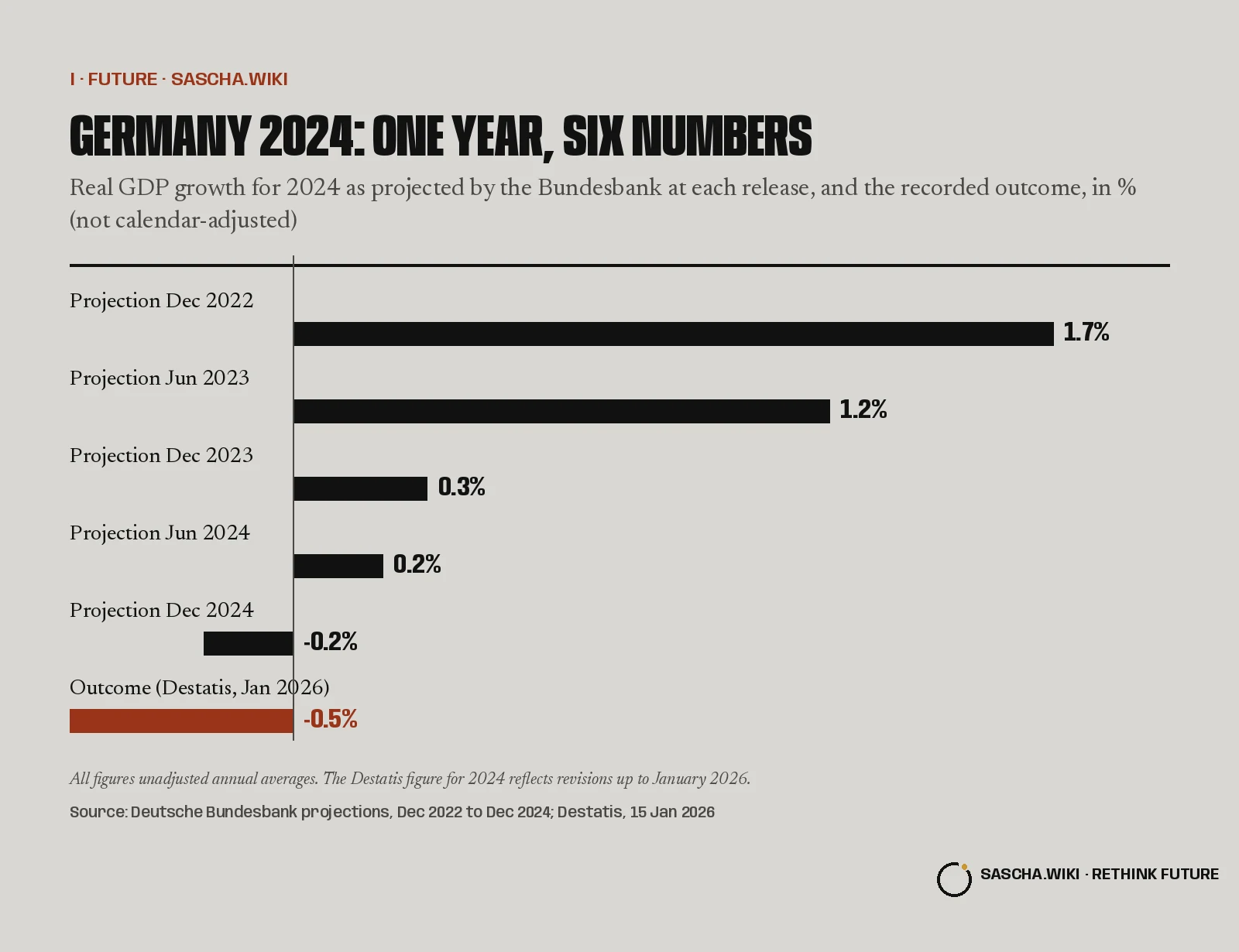
Take the German economy in 2024. In December 2022 the Deutsche Bundesbank expected it to grow by 1.7%.1 In June 2023 the figure was 1.2%,2 in December 2023 0.3%,3 in June 2024 0.2%4 and in December 2024 minus 0.2%.5 The Federal Statistical Office now puts the outcome at minus 0.5%.6 Nobody was careless; each projection was a sober reading of the data of its season. Read in sequence, though, the numbers look less like a view of 2024 than a diary of a national mood, slowly discovering that the recovery was not coming.
Hence the argument of this essay: forecasts say more about the mood of the moment than about the future, and the sensible response is not a better crystal ball but a different habit of mind.
The chimpanzee problem
The academic record is no kinder. In the studies of the psychologist Philip Tetlock, nearly 300 experts made predictions on political and economic questions with horizons of one to ten years. On average they were no more accurate than, in the phrase that made the research famous, dart-throwing chimpanzees.7 Tetlock later showed that some people, the “superforecasters”, can do markedly better. Even they meet a wall when the world moves faster than their assumptions. In a study co-authored by Tetlock and published by the Forecasting Research Institute in September 2025, domain experts and superforecasters had put the probability that an AI system would reach gold-medal level at the International Mathematical Olympiad by 2025 at just 8.6% and 2.3% respectively. It happened in July 2025.8
I spent years in direct marketing, for Microsoft, Quelle and Condé Nast, a trade in which the forecast is always confident and the reply card is always right. It cures you of certain ambitions.
What Shell understood
Shell says it has been developing possible visions of the future since the early 1970s.9 Pierre Wack, the method’s leading theorist, described its purpose without ornament: “the objective has never been to predict the future. The aim of a scenario is to modify a decision-maker’s mental model.”10 Before 1973, Shell’s planners had worked through futures with supply shortages and sharply higher prices alongside more comfortable ones. When OPEC cut production and the oil price rose fourfold, from 4 to 16 dollars a barrel, the unthinkable had at least been thought.10
A scenario is not a vaguer forecast. It is a small set of distinct, plausible stories, each internally consistent, none labelled “most likely”. Its value lies in rehearsal. The question moves from “what will happen?” to “what would we do if?”, and the second question has the advantage of being answerable.
Forecasts say more about the mood of the moment than about the future.
A rehearsal the size of continents
Demography is where forecasting feels safest. According to the United Nations’ World Population Prospects 2024, Africa’s population is projected to grow from about 1,550 million in 2025 to 2,467 million in 2050, while Europe’s falls from 744 million to 703 million and Asia’s rises from 4,835 million to 5,280 million.11 Japan is projected to lose 21 million people between 2024 and 2054. Germany is among the countries whose population has already peaked, while the United States is likely to keep growing through 2054, with immigration as the main driver.12
Even here the UN is careful. It expects the world population to peak at around 10.3 billion in the mid-2080s and attaches a probability of 80%, not certainty, to a peak within this century.12 Whoever plans for a city council in Kassel, a manufacturer in Nagoya or a university in Ohio does not need the exact figure for 2050. They need to have thought through a Europe that ages faster than expected, a Europe that grows through migration, and a world in which about a quarter of humanity is African, and to know which of their decisions hold in all three.
Preparing without predicting
None of this makes forecasts useless. They are good at describing the present, which is harder than it sounds. The mistake is to read them as a map of the future rather than as a weather report on our expectations.
The honest version of the December slide would therefore carry three stories instead of one number, and a single question beneath them: which of our plans works in all of them? That slide is less comfortable to sit on. It is, however, considerably harder to fall off.
Sources
- Deutsche Bundesbank: Perspektiven der deutschen Wirtschaft für die Jahre 2023 bis 2025 (Projektion Dezember 2022), December 2022
- Deutsche Bundesbank: Perspektiven der deutschen Wirtschaft bis 2025 (Projektion Juni 2023), June 2023
- Deutsche Bundesbank: Sinkende Inflation, aber noch keine Entwarnung (Projektion Dezember 2023), December 2023
- Deutsche Bundesbank: Deutschland-Prognose: Deutsche Wirtschaft fasst langsam wieder Tritt, Perspektiven bis 2026 (Monatsbericht Juni 2024), 2024-06-07
- Deutsche Bundesbank: Deutschland-Prognose: Wachstumsausblick deutlich eingetrübt, Inflation geht zurück auf 2 % (Monatsbericht Dezember 2024), December 2024
- Statistisches Bundesamt (Destatis): Bruttoinlandsprodukt im Jahr 2025 um 0,2 % gewachsen (Pressemitteilung Nr. 017), 2026-01-15
- Newsweek: Predicting the Future: The Supergroup of AI, Humans, Hedgehogs and Foxes (Marcus Weldon), 2025-09-22
- Forecasting Research Institute: Assessing Near-Term Accuracy in the Existential Risk Persuasion Tournament (Kučinskas, Tetlock, Karger et al.), 2025-09-02
- Shell: What are the previous Shell scenarios?, accessed 2026-09-29
- Polytechnique Insights: Case study: how Shell anticipated the 1973 oil crisis (Cabanes, Roger, Doganova), 2023-11-02
- INED, based on UN World Population Prospects 2024: Projections by continent (medium variant), July 2024
- United Nations, DESA Population Division: World Population Prospects 2024: Summary of Results, July 2024