
Listen
Soundtrack to the essay · Paper Remembers
Lower Left
Melodic techno, a slow Sunday focus: paper rustle, soft brushed hats, tape-warm arps.
Intro
Sunday, a coffee ring on the front page
Verse
Where was the story? Lower left, beside the photograph
The hand remembers before the mind
On the glass the hand stays still
Drop
Paper gives the words a place
And memory holds on to places
Verse
Fifty-four studies, a small and stubborn margin
No notifications, it stays where you left it
Drop
Paper gives the words a place
And memory holds on to places
Outro
Just above the fold
Music and vocals are AI-generated; the lyrics draw on the essay. The EBM version is instrumental. All twelve pieces: Rethink Future 2027.
Picture a Sunday table with a newspaper spread across it, coffee ring included, and beside it a tablet showing the same edition. Ask the reader an hour later where a particular story was, and the answer comes with a gesture: lower left, next to the photograph, just above the fold. Ask about the tablet and the hand stays still. Paper gives what we read a place, and a place is something memory can hold on to.
That is the argument, put plainly: paper does not store more than a screen, but it helps us keep more of what we read.
What the studies measure
The evidence is modest in size and remarkably persistent. In 2018 a team around Pablo Delgado and Ladislao Salmerón pooled 54 studies with 171,055 participants, published between 2000 and 2017, that compared comprehension of texts read on paper and on screens.1 Paper won by a small but significant margin. The advantage grew under time pressure, held for informational texts and vanished for narrative ones. Most striking, it increased over the years covered, the opposite of what one would expect if readers were simply growing used to screens. A second meta-analysis, published in 2023 by Salmerón and colleagues, looked at 49 studies of reading on phones and tablets and found the same small advantage for print, most pronounced among university students.2
The effects are not dramatic, and nobody should conclude that screens make us stupid. The researchers describe a “shallowing” effect: digital environments invite quicker, more superficial reading, especially when time is short. A printed page does not compete for attention. It sends no notifications, and it stays where you left it.
The market that declined to disappear
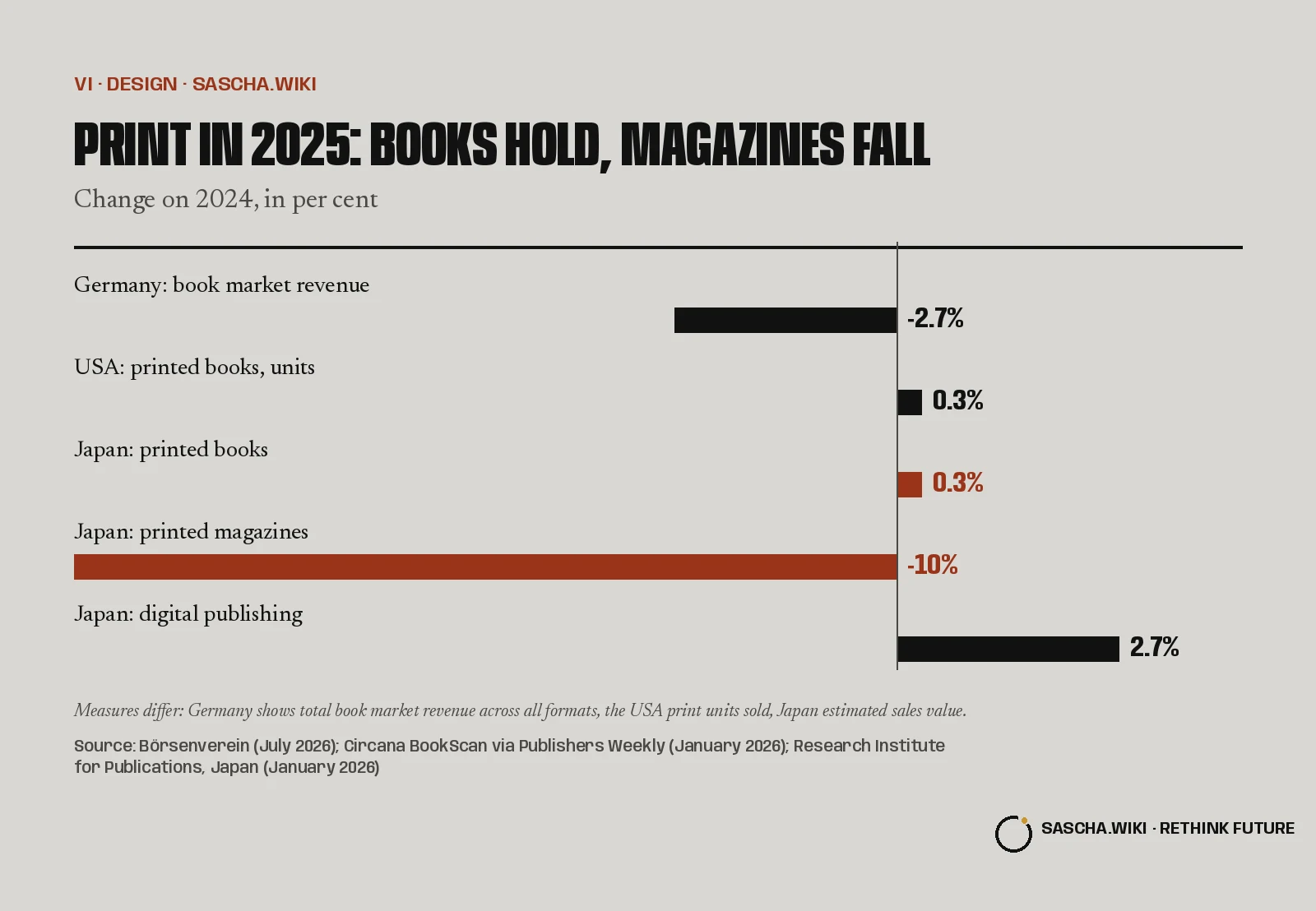
E-books have been about to replace printed books for roughly as long as the paperless office has been about to arrive. The figures for 2025 tell a quieter story. In Germany the booksellers’ and publishers’ association Börsenverein reports revenue of 9.6 billion euros, down 2.7%, and 25.9 million book buyers, about a third of the population aged ten and over; e-books accounted for just 6.3% of consumer book sales, and publishers brought out 9.8% fewer new titles.3 In the USA, Circana BookScan counted 762.4 million printed books sold, a rise of 0.3% and the second year of slight growth, though still below the pandemic peak of 839.7 million in 2021.4 In Japan, the Research Institute for Publications reports that the print market fell 4.1% to 964.7 billion yen, below one trillion yen for the first time since the 1970s. Almost all of the fall came from magazines, which lost 10%, while printed books grew by 0.3%. Digital publishing, more than nine tenths of it manga, reached 37.6% of the market.5 For scale: at its 1996 peak, Japan’s print market was worth 2.6 trillion yen.6
Across three very different countries the pattern is similar. What migrates to the screen first is the periodical and the disposable. The book, the object people keep, holds its ground.
Paper gives what we read a place, and a place is something memory can hold on to.
The photograph on the wall
Photography teaches the same lesson in a harder light. A phone holds thousands of pictures and shows them all at the same size, in the same glow, one swipe from the next. A print has made a choice. Somebody decided that this frame, out of all the frames, deserved paper, a margin, perhaps a wall. It shifts a little with the daylight. It hangs in a hallway where it is passed a dozen times a day without a glance, and then, on some unremarkable afternoon, it is looked at properly. The file is stored. The print is remembered. Anyone who photographs knows the difference between an archive and a selection. The archive grows by itself. The selection requires a commitment, and it is the commitment that turns a picture into something one remembers.
None of this makes paper virtuous or screens villainous. Screens are superb for finding; paper is better for keeping. The sensible conclusion is a division of labour: search on the screen, read what matters on the page. Paper remembers because it stays put, ages visibly and asks for a decision before it exists at all. In a culture that stores everything and returns to very little, that may be its most useful quality.
Sources
- Educational Research Review (Delgado, Vargas, Ackerman, Salmerón): Don’t throw away your printed books: A meta-analysis on the effects of reading media on reading comprehension, September 2018
- Journal of Educational Psychology (Salmerón, Altamura, Delgado, Karagiorgi, Vargas): Reading comprehension on handheld devices vs. on paper: A narrative review and meta-analysis of the medium effect and its moderators, 2023
- Börsenverein des Deutschen Buchhandels: Buchmarkt kompakt 2025/2026: Aktuelle Zahlen und Trends, July 2026
- Midland Paper, citing Publishers Weekly and Circana BookScan: Print Book Sales Rose Slightly in 2025, 2026-01-12
- hon.jp, data from the Research Institute for Publications (Shuppan Kagaku Kenkyūjo): 2025年出版市場(紙+電子)は1兆5462億円で前年比1.6%減、コロナ前の2019年とほぼ同規模, 2026-01-26
- Billboard Japan: 2025年出版市場発表 紙は4.1%減、電子は2.7%増, 2026-01-27