
Listen
Soundtrack to the essay · Gifts We Cannot Afford
Later
Melodic techno, a bittersweet winter night: icy bell-like arps, sub bass, a long silence before the drop.
Intro
Two seconds of silence as the paper falls
Verse
The giver watching, the face being arranged
A scarf in four instalments, and not from greed
Forty-nine cents set aside for the ribbon
Drop
The silence does not grow with the receipt
Later, the kindest word they ever sold
Verse
A gift is a sentence in a long conversation
Nobody wants to be the one who says nothing
Drop
The silence does not grow with the receipt
Later, the kindest word they ever sold
Outro
The generosity is real, the money comes later
Music and vocals are AI-generated; the lyrics draw on the essay. The EBM version is instrumental. All twelve pieces: Rethink Future 2027.
There is a particular silence at the moment a present is unwrapped: the giver watching the receiver’s face, the receiver arranging it. It lasts about two seconds, and it has financed entire retail sectors. Christmas gifting is one of the few rituals almost everyone still keeps, and in recent years it has quietly acquired a credit line. The generosity is real. The money, increasingly, arrives later.
The arithmetic of goodwill
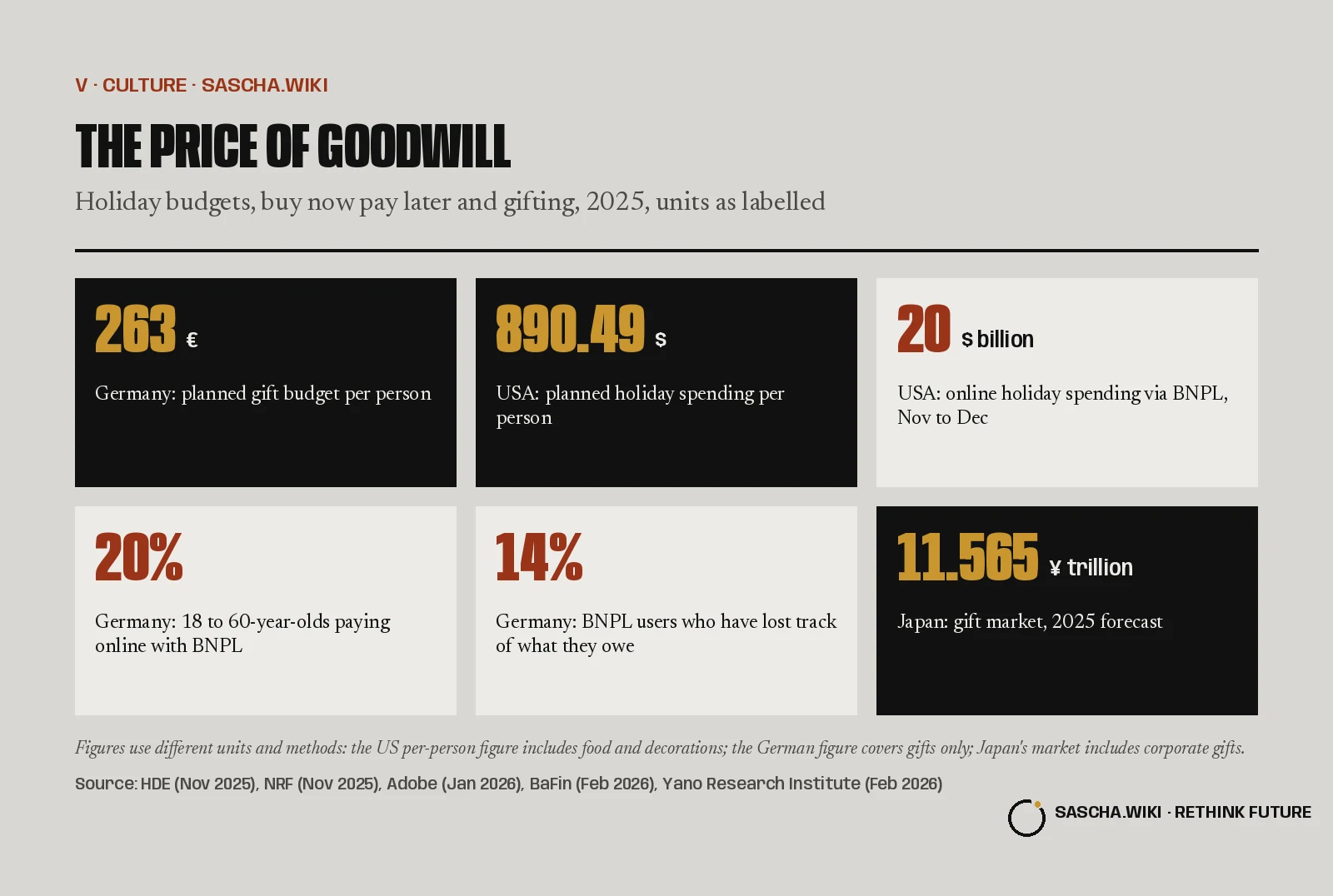
In Germany the retail association HDE expected sales of €126.2 billion in November and December 2025, a nominal rise of 1.5% that, once prices are accounted for, amounted to standing still.1 The more telling figure was the smaller one: shoppers planned to spend €263 each on presents, €34 less than the year before. Just over half of non-food retailers expected a weaker season.1
Across the Atlantic the mood was brighter, at least on paper. The National Retail Federation forecast US holiday sales of $1.01 trillion to $1.02 trillion for the same two months, the first time the figure had been expected to pass a trillion, with consumers planning to spend $890.49 each on gifts, food, decorations and seasonal items.2 The forty-nine cents are my favourite part of that number. Somebody, somewhere, budgeted for the ribbon.
Later, the kindest word in retail
The quieter change is in how the presents are paid for. Adobe, which tracks online checkouts at US retailers, counted $20 billion of holiday spending through buy now, pay later between 1 November and 31 December 2025, up 9.8% on the year. Cyber Monday alone was the biggest BNPL day on record, at $1.03 billion.3
The US Consumer Financial Protection Bureau, looking at credit records, found that 21.2% of consumers with a credit file used BNPL in 2022, and that about 63% of borrowers took out several loans at the same time at some point in the year.4 In Germany, the financial supervisor BaFin reported in February 2026 that 20% of consumers aged 18 to 60 use BNPL when shopping online. One in seven users (14%, and 24% among the under-30s) has at some point lost track of what they owe.5
In 1996 I co-founded one of Germany’s first digital agencies. Among the many things none of us predicted was that the most persuasive word the internet would ever sell was “later”.
The two-second silence after the paper comes off does not scale with the receipt.
Generosity as a contract
It would be easy to scold, and pointless. Nobody splits a cashmere scarf into four instalments out of greed. They do it because a gift is a sentence in a long conversation, and saying nothing would also be a sentence. Anthropologists call it reciprocity; everyone else calls it not wanting to be the one who turned up empty-handed.
Japan has formalised this more elegantly than most. Ochugen in summer and oseibo at the end of the year are gifts of thanks to those one feels indebted to: clients, teachers, the boss, the relative who helped with the move. Yet the formal ritual is fading while gifting itself grows. Yano Research Institute expected Japan’s gift market to reach ¥11.565 trillion in 2025, up 3.4%, with digital e-gifts growing fastest, forecast at ¥645 billion.6 7 The seasonal ochugen and oseibo trade, a market of around ¥1.5 trillion, was already shrinking by 0.8% in 2022 while the wider gift market grew by 4%.8 The obligation is loosening. The affection, apparently, has moved online.
Picture a small office in Osaka in early December: a box of immaculate fruit arrives with a formal card, for a business relationship both sides privately wish were more relaxed. Now picture a flat in Berlin the same week, where a pair of headphones is ordered at midnight in four instalments. Different rituals, the same quiet question: am I giving enough to stay in the circle?
What the gift is for
The social pressure of generosity is not a fault in the system. It is the system. Presents hold relationships in place the way stitches hold a seam, and a family that stopped exchanging them would not become more rational, only thinner. The trouble begins when the price of belonging rises faster than income, and the gap is bridged by a payment plan with a friendly name.
Many families have long since found their own quiet treaties: a ceiling agreed in November, names drawn from a hat, an afternoon given instead of an object. None of them is heroic. All of them require the one thing BNPL was designed to spare us, which is an awkward conversation before the purchase rather than a private one after it.
Anyone who photographs people learns early that faces are poor at pricing. The two-second silence after the paper comes off does not scale with the receipt. It is, as far as I can tell, the only part of Christmas that cannot be paid for in instalments, and the only part anyone remembers in February.
Sources
- Handelsverband Deutschland (HDE): Weihnachtsgeschäft: Handelsverband rechnet mit Umsatzplus von 1,5 Prozent im Vergleich zum Vorjahr, 2025-11-05
- National Retail Federation (NRF): NRF Expects Holiday Sales to Surpass $1 Trillion for the First Time in 2025, 2025-11-06
- Adobe: Adobe: Holiday Shopping Season Drove a Record $257.8 Billion Online with Consumers Embracing Generative AI Tools, 2026-01-07
- Consumer Financial Protection Bureau (CFPB): CFPB Research Reveals Heavy Buy Now, Pay Later Use Among Borrowers with High Credit Balances and Multiple Pay-in-Four Loans, 2025-01-13
- BaFin (Bundesanstalt für Finanzdienstleistungsaufsicht): Buy now, pay later: Jede(r) Siebte verliert schon mal den Überblick, 2026-02-02
- Yano Research Institute (矢野経済研究所): ギフト市場に関する調査を実施(2025年) (Survey of the gift market, 2025), 2026-02-13
- MarkeZine: 2025年ギフト市場規模は11兆5,650億円に拡大と予測【矢野経済研究所調査】 (Gift market forecast to grow to ¥11.565 trillion in 2025), 2026-02-17
- Diamond Retail Media (data: Yano Research Institute): 多様化するギフト機会の中で、減少続く中元・歳暮の生きる道 (How ochugen and oseibo survive as gifting occasions diversify), 2023-06-29