
Listen
Picture the morning after an American election. On the television the maps are still filling with colour, and the commentators are explaining what they had always suspected. In a break room somewhere in the Midwest, a warehouse worker spends her fifteen minutes on the phone: first to a garage, then to her bank, then to the garage again. The repair costs more than she has. She is back at her station on time, and so is her money stress. Her attention follows a few hours later.
The scene is invented but not unusual, and it contains the argument of this essay. America’s financial fragility is not a side issue of social policy. It is a productivity bill that employers pay every week and never book.
The thin cushion of a rich country
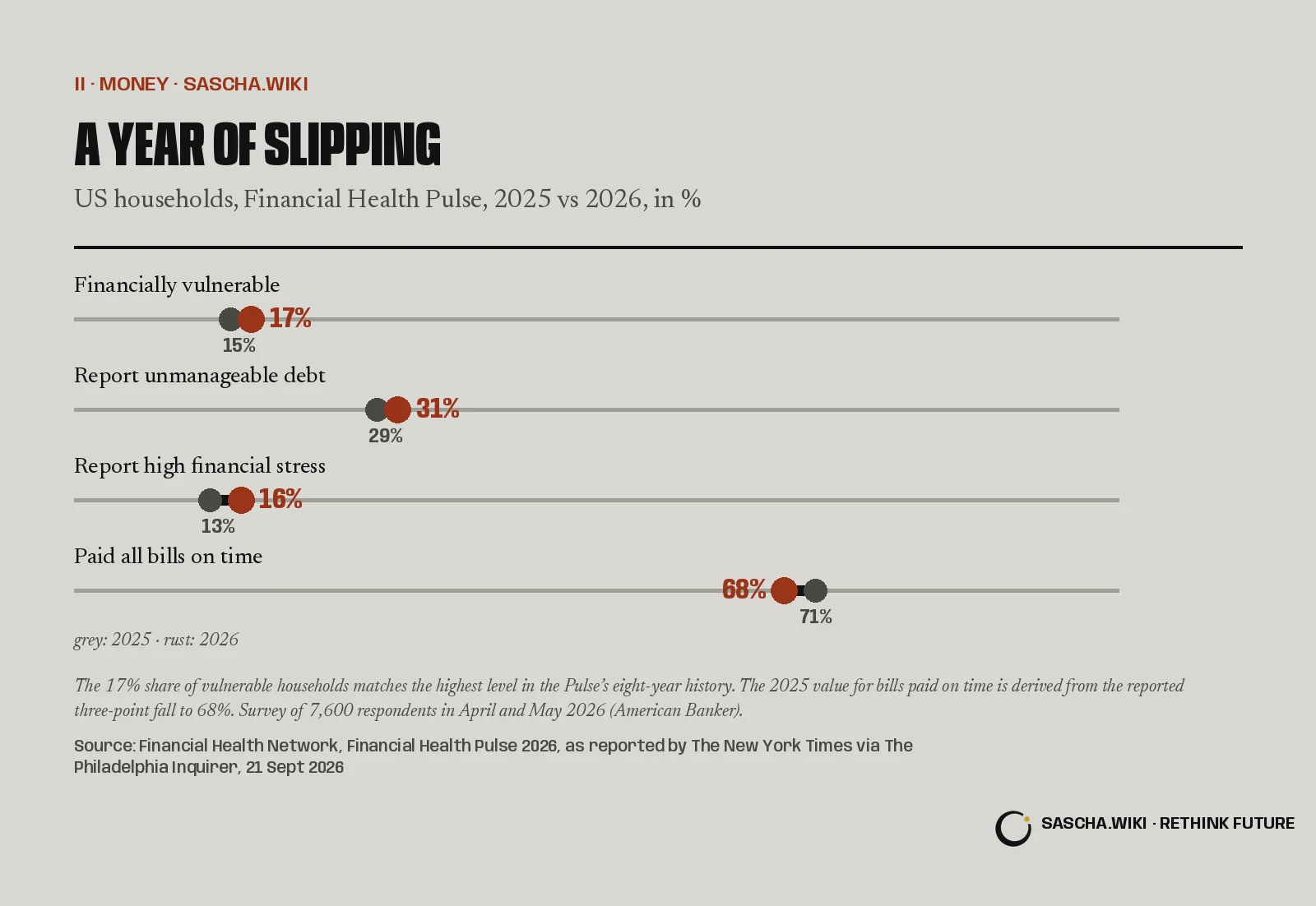
For eight years the Financial Health Network has published an annual reading of American household finances, the Financial Health Pulse.1 In the 2026 edition the share of households classed as financially vulnerable rose from 15% to 17%, matching the highest level since the series began.2 That is roughly 23 million households, 1.8 million more than in 2025.3 The share reporting unmanageable debt rose to 31%, the share paying all bills on time fell by three points to 68%, and the financially healthy have been stuck at just under a third for five years.2
Inside companies the picture comes into sharper focus. In PwC’s survey of nearly 3,500 American employees, carried out in January 2026, 59% said they were stressed about their finances. 53% had less than $5,000 set aside for emergencies, and 30% less than $1,000.4 This, then, is the rainy-day fund of the world’s largest economy: four figures at most for more than half of the employees surveyed, three figures at most for almost a third.
Where the bill lands
Money stress does not wait politely at the factory gate. A survey carried out in 2024 with Workplace Intelligence for BrightPlan estimated that workers lose 7.3 hours of productivity a week to financial worries, potentially costing American employers $183bn a year.5 The figure comes from a provider of financial wellness services and is an extrapolation, so it is best read as an order of magnitude. The mechanism is hardly mysterious: a mind busy recalculating a repair bill is not entirely on the spreadsheet, the customer or the forklift. Halve the estimate, and any finance director would still notice the sum.
Employers are not blind to the subject, merely optimistic about it. In Bank of America’s 2026 benefits report, 71% of employers rated their workforce’s financial wellbeing as good or excellent. Only 55% of employees agreed, and three-quarters named the cost of living as a threat to their financial security. Conversely, 39% said they stayed with their employer precisely because its benefits were competitive.6 The survey covered only companies with 401(k) plans and their staff, the comfortable end of the labour market. A year earlier the same bank had found that 24% of employees had recently left an employer, or considered leaving, because its benefits were lacking, up from 15% in 2023.7 Sooner or later, the bill turns up in the recruitment budget.
It is a productivity bill that employers pay every week and never book.
What gets booked, and what does not
Elsewhere it is plain what happens once a cost is taken seriously. German employers can put a figure on illness: the German Economic Institute in Cologne estimated the cost of continued pay for sick employees in 2025 at 85.6 billion euros, a sum that has more than doubled in nominal terms within fifteen years.8 Japan has gone further and turned health into a management discipline. In March 2026, 26,850 organisations were certified under the government’s programme for “health and productivity management”.9 In Germany and in Japan, illness has its own line in the accounts. Money worries rarely have one anywhere.
America already has a tool to start with. Since 2024, federal law has allowed employers to attach an emergency savings account to the retirement plan, known in the trade as a PLESA, with contributions of up to $2,500 that staff can withdraw without the penalties of drawing on retirement savings.10 It is designed to be small, a cushion for precisely the kind of repair bill that ruined the break. Hardly any employer offers it. Vanguard found “minimal to no interest from plan sponsors” up to the end of 2025, and in a separate poll by the Plan Sponsor Council of America not a single sponsor in the sample offered one. One sponsor explained that they “do not wish to function as a bank”.11 Their employees, one suspects, would settle for a balance.
A column for the morning after
None of this depends on an election result. It depends on an accountant. An HR department that knows its absence rate to the decimal point might also want to know how many hours are spent, mentally, elsewhere. If companies recorded the hours lost to money worries as carefully as they record absences, the case for payroll saving and financial advice would be made in a budget meeting rather than in a stump speech. This autumn’s figures stand whoever won on Tuesday: 17% of households vulnerable, more than half of employees with a thin cushion, and a rule that hardly any employer uses. A superpower can afford a great many things. It is curious that a rainy-day fund for its own workforce is not yet among them.
Sources
- Financial Health Network: Financial Health Pulse® 2026 U.S. Trends Report: Stressors Mount and Vulnerability Returns (report page), September 2026
- The Philadelphia Inquirer / The New York Times (Ann Carrns), on the Financial Health Pulse 2026: More U.S. households are struggling financially, analysis finds, 2026-09-21
- American Banker (Kate Berry): Consumers’ financial vulnerability hits record high: Report, 2026-09-24
- PwC US: PwC 2026 Employee Financial Wellness Survey, 2026-04-14
- BrightPlan with Workplace Intelligence: 2024 BrightPlan Wellness Barometer Survey Report (press release), 2024-04-30
- Bank of America: BofA Report: Financial Wellbeing of Employees at U.S. Companies Hits Four-Year High, Even as Cost-of-Living Pressures Persist (2026 Workplace Benefits Report), 2026-07-21
- Bank of America: BofA Report: Percentage of Workers Seeking Near-Term Financial Guidance from Employers Doubles (2025 Workplace Benefits Report), 2025-09-03
- Institut der deutschen Wirtschaft (IW), Jochen Pimpertz: Entgeltfortzahlung bei Krankheit kostet 85,6 Milliarden Euro, 2026-08-29
- HR Pro, reporting the announcement by Japan’s Ministry of Economy, Trade and Industry (METI): 健康経営優良法人2026が決定: 人的資本重視で認定は約2.7万社に拡大。「健康経営銘柄2026」は28業種44社に (Health and Productivity Management Outstanding Organizations 2026 announced), 2026-03-09
- U.S. Department of Labor, Employee Benefits Security Administration: US Department of Labor issues guidance on new emergency savings accounts, 2024-01-17
- Plan Sponsor Council of America (Zachary Dennis): Plan Sponsors Remain Wary of In-Plan Emergency Savings Accounts, 2026-08-06