
An AI tax might help fund changes in working life. Before choosing a tax, we should agree on what we want it to achieve.
The report is finished. Yesterday someone might have spent an hour on it. Today it takes twenty minutes, including checks. An imagined example, but the next question is real: what happens to the forty minutes?
They could make room for better work. They could become time off. They could disappear into the next task. Or show up as savings in the company's accounts.
That is where the AI tax debate begins for me: with time, income and a fair share of progress.
A proposal, not a settled policy
LinkedIn's editorial team asked me whether an AI tax should fund retraining and new jobs. The German political context needs care. On 13 October, digital minister Karsten Wildberger raised the idea of taxing AI-related revenue. He qualified that position later the same day. This is a debate, not a finished tax policy. (ntv, in German)
The underlying question remains useful. If AI changes how work and income are distributed, funding for public services needs to keep up. Using AI does not make a business exempt from tax. But systems that rely heavily on income from work should examine possible changes in that income.
Faster does not automatically mean freer
Gallup's October report found that 63% of surveyed US employees who had used AI at work at least a few times in the previous year said it helped them work faster. Meanwhile, 31% of that user group reported additional responsibilities from their employer. Fieldwork ran from January to March. These are people's assessments, not a measured productivity effect that can be transferred directly to Germany. (Gallup)
A minute saved and a minute available to you are different things. How we turn one into the other deserves attention.
Three different accounts
First, the company's accounts. In a simplified example, revenue of 100 and costs of 90 leave a profit of 10. A levy on revenue taxes a different base from a tax on profit. We would also need to decide which revenue can meaningfully be attributed to AI.
Second, the task itself. A cheap AI call need not produce a cheap finished task. Retries, checks and corrections belong in the calculation. The Wall Street Journal has reported on both unpredictable AI spending and competition over model prices. My conclusion is to examine useful completed work before drawing policy conclusions from usage units. (WSJ on spending, WSJ on prices)
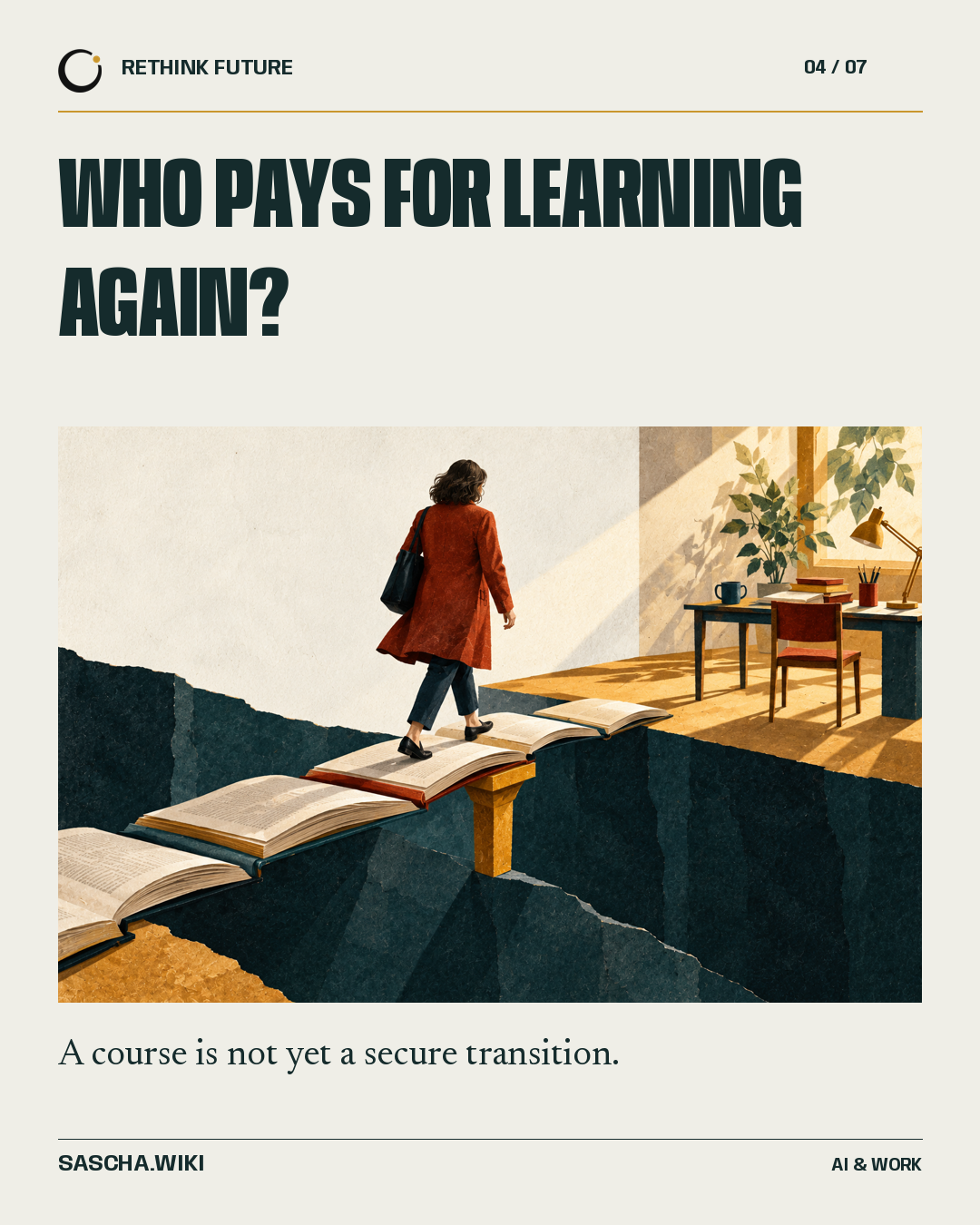
Third, the household budget. Someone changing careers still has rent and responsibilities. Access to a course is only part of a transition. I would put paid learning time and a realistic next role at the centre of funding decisions.

Choose the tool after the purpose
The Economist's public podcast description of 6 October connects AI to future public revenues. Brookings' analysis of 27 October examines different tax proposals and their possible trade-offs. One label covers several different problems. (The Economist, Brookings)
I would use three tests. Can people do better work? Can they afford the transition to different work? Do economic gains contribute appropriately to shared needs?
I am not persuaded by a blanket levy on every use of AI. I would start with those three goals and judge the policy by how well it serves them.
Additional local infrastructure costs need a clear allocation too. Any new levy should be judged by what it achieves and what it makes more expensive. Simply using a helpful tool would not, for me, be enough reason for a special charge.
The machine does not pay income tax. We can still make deliberate choices about its gains, its costs and our time.
That seems a useful place to begin a new agreement about progress.
Sascha Schulz. Opinion, 28 October 2026.