Listen
Imagine a Thursday afternoon in a mid-sized German firm. An email from the training department announces a mandatory course in AI literacy: twenty-five minutes, a short quiz, deadline Friday. Most recipients let the video run in one window while, in the window next to it, a chatbot drafts the report that is actually due. By Friday evening the learning platform shows a satisfying column of green ticks. Everyone has been trained. Whether anyone has learnt anything appears on no list.
The scene is invented; its logic is not. It holds the whole argument of this essay: Europe made AI literacy a legal duty and then softened it, yet what decides the matter is not the article but whether employers turn their people into coaches of their tools rather than spectators.
What the article says, and what it said
Since 2 February 2025, Article 4 of the EU AI Act has applied to every organisation that provides or deploys an AI system. In its original wording, they had to “take measures to ensure, to their best extent, a sufficient level of AI literacy” among their staff and anyone else operating AI on their behalf1. Since August 2026, national market surveillance authorities have been responsible for supervising and enforcing the duty. No certificate is required; an internal record of training will do2.
Then Brussels reached for the red pen. The Digital Omnibus on AI, Regulation (EU) 2026/1744, took effect in July 20263. Organisations must now “take measures to support the development of AI literacy”, and no specific, or “sufficient”, level is mandated any longer. Those deploying high-risk systems must still ensure that their staff are trained for human oversight2. Legislators have thus rediscovered what every teacher knows: “sufficient” is the hardest grade to define.
The duty has not vanished, but its character has changed. An obligation aimed at an outcome has become an obligation to make an effort, and effort, unlike ability, fits very neatly into a spreadsheet.
A rule known mainly to its authors
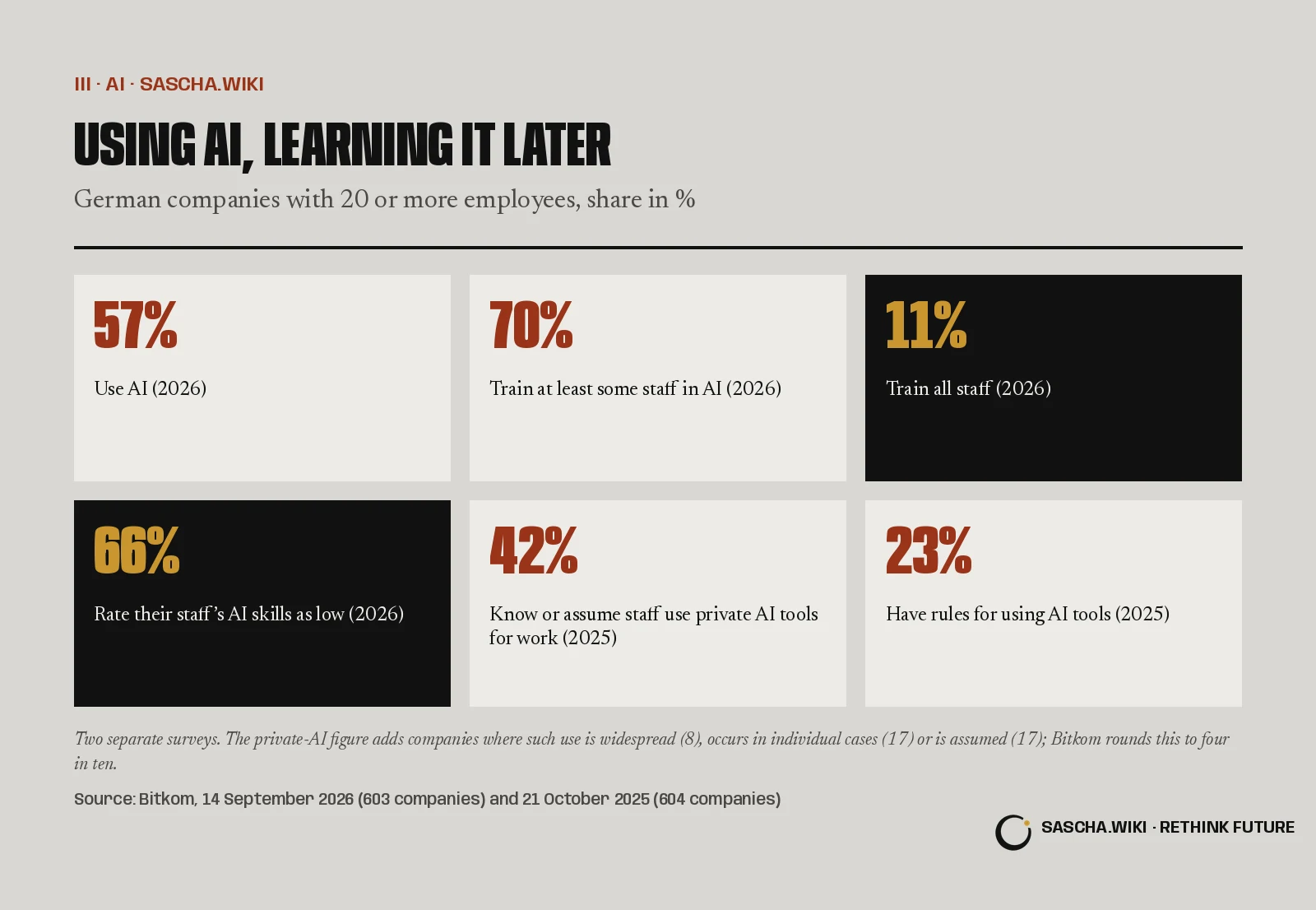
Few people had been waiting for it. In a study by KPMG and the University of Melbourne, published in May 2025, 91% of Germans said they knew of no specific legal requirements on AI4. Companies, meanwhile, had set off without them. According to Bitkom, 57% of German firms with 20 or more employees now use AI, against 36% a year earlier. Yet 66% rate their staff’s AI skills as low and only 28% as high. A quarter offer no training whatsoever, and roughly one firm in nine trains everyone5.
Improvisation fills the gap. In an earlier Bitkom survey, four companies in ten said they knew or assumed that employees were using private AI tools for work; in 8% the practice was widespread, twice the share of the year before. Only 26% provided access to generative AI of their own, and 23% had set rules for its use6. In four firms out of ten, then, some of the software doing the actual work has never been introduced to the IT department.
Nobody becomes a coach in twenty-five minutes with the sound off.
Coaches, not spectators
Washington has so far preferred encouragement to obligation. In August 2025 the Department of Labor urged states to spend federal workforce funds on AI literacy7. The more instructive American evidence comes from Gallup, which surveyed 23,717 employees. Where AI tools were available, 78% of those who strongly agreed that their manager actively supports AI use were frequent users, against 44% of everyone else8. Literacy, it seems, travels less through courses than through the person who signs off the work.
Japan shows the same pattern from the other side. Its communications ministry reports that 68.9% of Japanese companies now have a policy of using generative AI, up from 49.7% a year earlier but still below the United States, Germany and China9. Among firms that do not ban the technology, 27.0% say there is no organised effort to use it at all, a markedly higher share than in the other three countries10. Permission, it turns out, is a long way from practice.
An earlier essay here argued that at school the machine should coach and the pupil should play. At work the roles reverse: the tool does much of the playing, and someone has to coach it. This is where the difference between coaches and spectators matters. Spectators watch a tool perform, applaud when it dazzles and grumble when it fails. Coaches know what a good result looks like, design the exercises, spot the recurring error and decide when to stop play. Nobody becomes a coach in twenty-five minutes with the sound off. People become coaches when their own cases, their own mistakes and their own managers are part of the training.
The small print, read aloud
Picture the same firm in the spring of 2028. The email now invites a team to spend an afternoon testing a chatbot on three of its own recent cases, with the head of department in the room and the errors written up on a whiteboard. The learning platform has less to report. The firm knows considerably more.
Neither version of Article 4 ever asked for a certificate. Both asked, in a quiet legal voice, that people who work with machines should understand them. That was always the sensible part, and it has survived the amendment intact. The duty nobody read can still be fulfilled by people who never needed to read it, provided someone lets them practise.
Sources
- European Commission, AI Act Service Desk: Article 4: AI literacy (Regulation (EU) 2024/1689, original text as published in the Official Journal), 2024-07-12
- European Commission: AI Literacy: Questions & Answers, 2026-07-27 (last update)
- Cuatrecasas: Digital Omnibus on AI has been published (Regulation (EU) 2026/1744), 2026-07-24
- KPMG Deutschland and University of Melbourne: Zwischen Alltag und Sorge: Zwei Drittel der Deutschen nutzen KI, doch nur wenige vertrauen der Technologie, 2025-05-12
- Bitkom: Erstmals nutzt die Mehrheit der Unternehmen KI, 2026-09-14
- Bitkom: Beschäftigte nutzen vermehrt Schatten-KI, 2025-10-21
- U.S. Department of Labor: Guidance to states on using Workforce Innovation and Opportunity Act grants to bolster artificial intelligence literacy and training (news release), 2025-08-26
- Gallup: AI in the Workplace: What Separates Adopters and Holdouts, 2026-04-12
- Ministry of Internal Affairs and Communications (MIC), Japan (総務省): 令和8年版 情報通信白書: 生成AIの活用方針等 (White Paper on Information and Communications in Japan 2026: generative AI use policies), July 2026
- Ministry of Internal Affairs and Communications (MIC), Japan (総務省): 令和8年版 情報通信白書: 組織的な取組状況 (White Paper on Information and Communications in Japan 2026: organisational efforts), July 2026