
Listen
Imagine a double lesson on a Tuesday morning at a comprehensive school in Germany. The teacher draws a curve on the board: what 50 euros a month could grow into over forty years at a modest rate of interest. The line rises gently for a long time, then steeply. Someone at the back whistles. The class copies the curve, the bell rings, and it has been a good lesson. Now move one of those pupils forward twelve years, to a sofa at eleven at night, a phone and an online shop that offers to split the bill into later instalments. The curve is not on the screen. The button is.
The distance between the board and the button is the subject of this essay. More financial education is the most comfortable promise in politics, yet lessons on their own fade; financial health appears only when knowledge meets products and defaults that make the right choice easy.
Everyone wants the subject
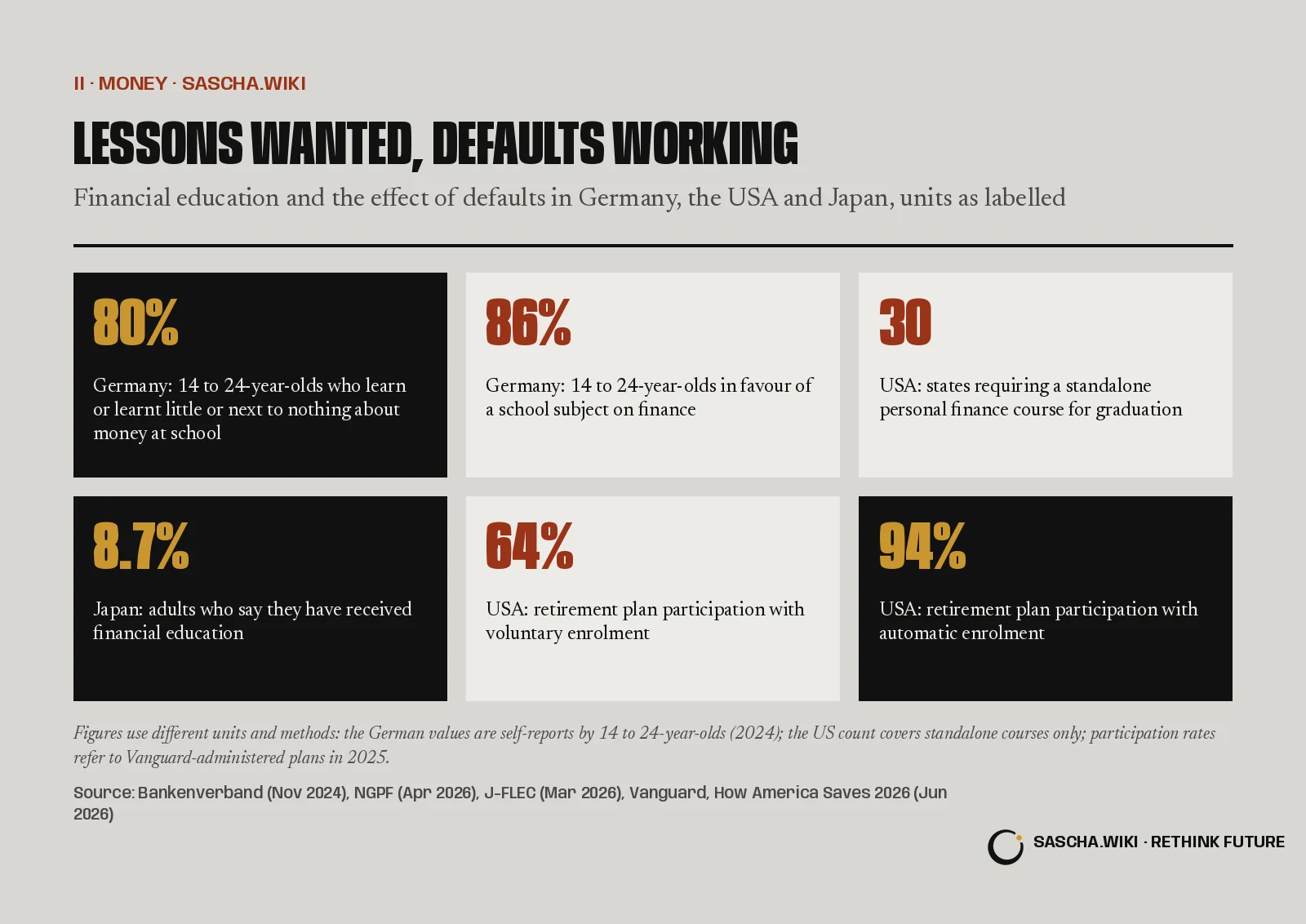
Demand is not the problem. In the Bankenverband’s youth study of 2024, 80% of Germans aged 14 to 24 said they were learning, or had learnt, little or next to nothing about business and finance at school, and 86% favoured a school subject devoted to it1. The United States has gone further. Thirty states now require a standalone personal finance course for high-school graduation, and once the rules are fully phased in, with the class of 2031, 76% of students at American public high schools will have to take one2. In Japan, the Japan Financial Literacy and Education Corporation, J-FLEC, surveyed 30,000 adults in the autumn of 2025: 8.7% said they had ever received financial education3, against 7.1% in the previous survey three years earlier4.
The attraction for politicians is easy to see. A curriculum has two qualities that governments prize: it is cheap, and it fails slowly, usually some time after the election after next.
What the evidence remembers
The research is more patient than the rhetoric. In 2014 Daniel Fernandes, John Lynch and Richard Netemeyer reviewed 201 studies and found that even large programmes with many hours of instruction had negligible effects on behaviour 20 months or more later. Their proposal was modest: teach “just in time”, close to the decision the lesson is meant to help with5. A later meta-analysis of 76 randomised experiments involving more than 160,000 people, published in the Journal of Financial Economics in 2022, was kinder. Financial education does improve knowledge and behaviour, by amounts similar to those achieved by education in other fields6.
The two findings do not contradict each other. Lessons work the way lessons work: strongest while fresh, weaker with every year of distance. Nobody expects a single term of French at fifteen to carry a conversation in Lyon at forty. The mistake lies not in teaching but in treating a lesson as a policy that is finished when the bell rings.
The curve is not on the screen. The button is.
Where the decision is made
The alternative is less glamorous. It consists of making the sensible option the easy one at the moment it is chosen, and American retirement saving is the textbook case. Under the SECURE 2.0 Act, most 401(k) and 403(b) plans set up on or after 29 December 2022 must, for plan years beginning after 31 December 2024, enrol employees automatically at 3 to 10% of pay, rising by one percentage point a year to at least 10%. Anyone may opt out7. Vanguard’s figures show what a default of this kind does. In 2025, participation reached 94% in plans with automatic enrolment and 64% in plans where employees had to sign up themselves8. Much of that thirty-point gap is the work of a box ticked in advance.
Germany is about to try a version of the same idea for borrowing. From 20 November 2026, two days after this essay appears, most of the country’s new consumer credit law takes effect9. It also covers loans under 200 euros and interest-free credit, including many buy-now-pay-later offers. Lenders must assess creditworthiness first and take into account obligations from earlier purchases of this kind10. It is “just in time” in legal form: the question arrives at the button, not in the classroom.
A lesson with a button
This is no case against teachers. Knowledge still matters, because a default helps only those who can tell when to leave it, and no credit check reads the contract on anyone’s behalf. But the division of labour should be clear. Schools can explain the curve. Employers, lenders and legislators decide whether the curve is waiting at the point of decision or twelve years and one sofa away.
The politician who promises more financial education promises something good that will not be tested for a decade. The one who changes a default, a contract or a checkout promises something smaller that can be measured by next year. Both are needed. Only one of them is ever in short supply.
Back to the Tuesday lesson, then. The curve on the board was right. It simply has to be waiting at the checkout, as a box already ticked for saving, as a question that comes before the credit, and as a contract short enough to read before the button is pressed.
Sources
- Bundesverband deutscher Banken (Bankenverband): Jugendstudie 2024: Auswahl Finanzwissen und Finanzbildung, 2024-11-13
- Next Gen Personal Finance (NGPF): How Many States Require Students to Take a Personal Finance Course for High School Graduation?, 2026-04-06
- J-FLEC, Japan Financial Literacy and Education Corporation (金融経済教育推進機構): 金融リテラシー調査(2025年)のポイント (Financial Literacy Survey 2025: key points; fieldwork 26 September to 17 October 2025, 30,000 respondents), 2026-03-27
- Central Council for Financial Services Information, Japan (金融広報中央委員会): 金融リテラシー調査 2022年調査結果のポイント (Financial Literacy Survey 2022: key points), 2022-07-05
- Management Science (Fernandes, Lynch, Netemeyer): Financial Literacy, Financial Education and Downstream Financial Behaviors, 2014
- Journal of Financial Economics (Kaiser, Lusardi, Menkhoff, Urban), via DIW Berlin: Financial Education Affects Financial Knowledge and Downstream Behaviors (vol. 145), 2022
- Internal Revenue Service, U.S. Treasury (Federal Register, vol. 90, no. 8): Automatic Enrollment Requirements Under Section 414A (proposed regulations), 2025-01-14
- Vanguard: How America Saves 2026, June 2026
- KPMG Klardenker (Financial Services Hub): Gesetz zur Umsetzung der Verbraucherkreditverträge-Richtlinie im BGBl. veröffentlicht (BGBl. 2026 I Nr. 139), 2026-05-18
- IWW Institut für Wissen in der Wirtschaft: Gesetzgebung: Beschlossene Sache: Neue Spielregeln im Verbraucherkreditrecht ab November 2026, 2026-06-12