

Listen

Soundtrack to the essay · The Second Half
Second Half
Melodic techno, mature and uplifting: warm monosynth bass, rolling toms, a lead that soars in the second drop.
Intro
Same players, same pitch
Verse
Half-time, and nobody says the game is over
Fifty-seven, second row, the software still new
The teacher is thirty-one, and no one looks up
Drop
Not wound down, rebuilt
A different plan for the second half
Verse
Curiosity is not something you have
It is something you practise, Tuesday after Tuesday
Drop
Not wound down, rebuilt
A different plan for the second half
Outro
Everyone involved has already been born
Music and vocals are AI-generated; the lyrics draw on the essay. The EBM version is instrumental. All twelve pieces: Rethink Future 2027.
In football, the second half begins with the same players, the same pitch and a different plan. Nobody in the dressing room at half-time argues that the match is essentially over because forty-five minutes have been played. In working life the argument is made constantly, usually in silence, and often by the very people it concerns.
Picture a Tuesday evening in a training room, which could be in Hamburg, in Ohio or in Osaka. A woman of fifty-seven sits in the second row, laptop open, taking notes on a piece of software that did not exist two years ago. The instructor is thirty-one. Nobody finds this remarkable, which is the remarkable part.
The claim of this essay is simple: after fifty, a career is not something to wind down but something to rebuild, and curiosity, practised as a method rather than admired as a trait, is the most dependable tool for the job.
The arithmetic of age
Demography is the one forecast economists reliably get right, chiefly because everyone involved has already been born. In Germany, 27.0% of the labour force was 55 or older in 2025, up from 20.7% in 2015. Within the next fifteen years, 13.3 million people who were available to the labour market in 2025 will reach the statutory retirement age: 30.0% of the total.1 In the United States, 22.9% of the civilian labour force was 55 or older in 2025, and the share aged 65 and over is projected to rise from 6.9% to 8.2% by 2035.2
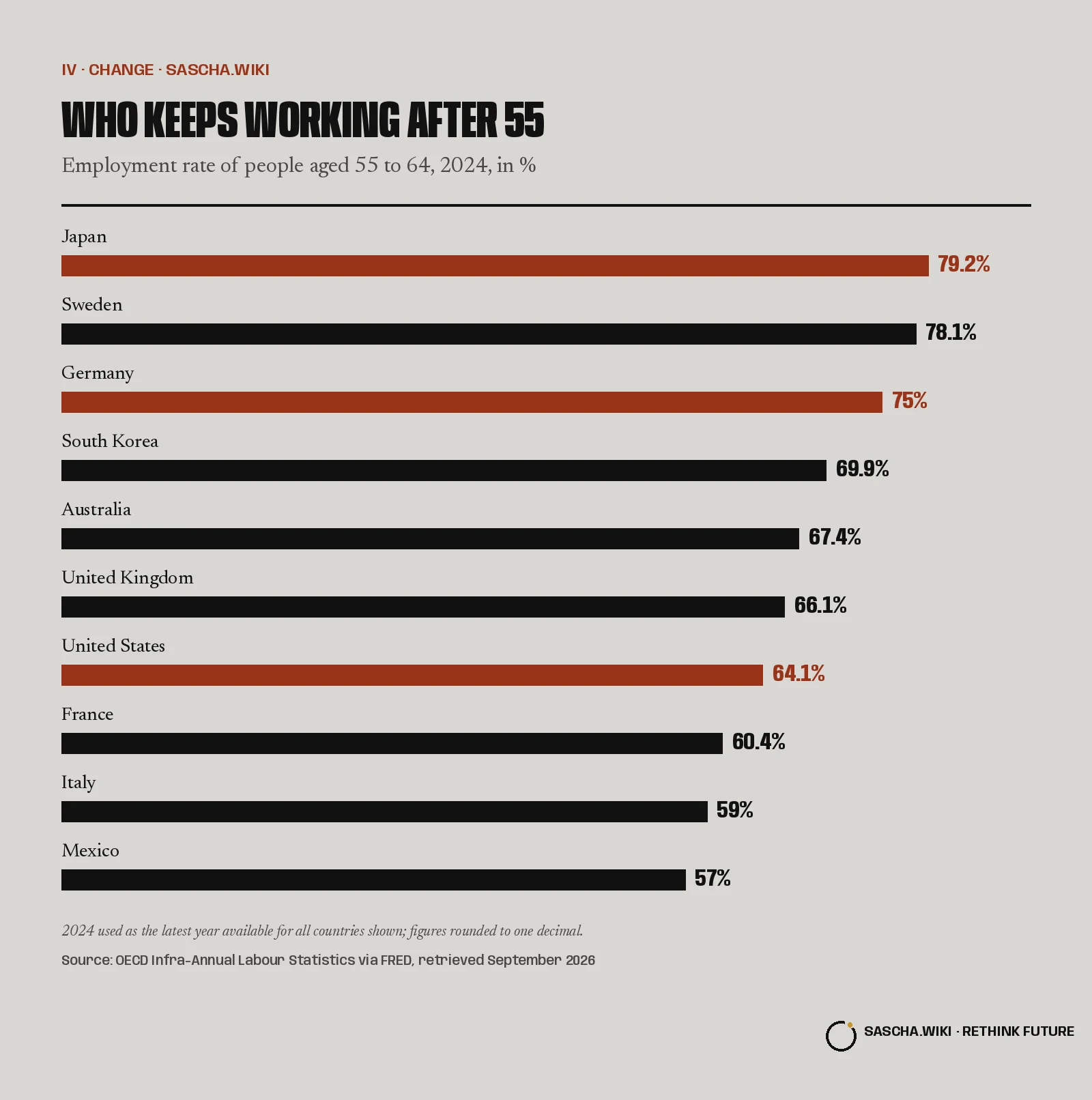
Japan is further down the same road. In 2025, 9.43 million people aged 65 and over were in work, the highest number on record, and they made up 13.8% of all employed people. The employment rate for those aged 65 and over reached 26.0%; among those aged 65 to 69 it was 54.5%.3 Across the rich world the pattern holds, with wide variation. In 2024, 79.2% of Japanese aged 55 to 64 were employed, against 75.0% in Germany and 64.1% in the United States, with Sweden close behind Japan and Mexico below the United States.4
A prejudice that outlives the data
The labour market needs older workers in aggregate and hesitates to hire them individually. In an AARP survey of American workers aged 50 and over, 64% said they had seen or experienced age discrimination at work, and 22% felt they were being pushed out of their jobs because of their age.5 The OECD, in its 2025 Employment Outlook, found that older workers who lose their jobs spend more time unemployed than younger ones and are significantly less likely to be re-employed.6
The prejudice is familiar: older people are slow with new tools, attached to old routines, expensive. It is also, like most prejudices, lazy about evidence. The more useful question is not whether it exists but what to do while it does.
Demography is the one forecast economists reliably get right, chiefly because everyone involved has already been born.
Learning as a permanent state
Germany’s Adult Education Survey offers a partial answer. In 2022, 54% of people aged 50 to 64 took part in some form of further training, against 61% of those aged 18 to 34.7 The gap is real, but it is smaller than the cliché. What matters is less the certificate than the condition: learning not as a phase that ends with a diploma, but as a permanent state, closer to fitness than to graduation.
I received a school scholarship at IBM at the age of eleven, long before the internet, and in 1996 I co-founded one of Germany’s first digital agencies. Nobody in that field had twenty years of experience, because the field was not twenty years old. Everyone was a beginner. The only real distinction was who was willing to remain one.
Curiosity as method
Curiosity is usually described as a temperament, something one either has or lacks. It works better as a method. In practice it looks unspectacular: a question asked where a statement would have been easier, a tool learnt on purpose rather than under duress, a younger colleague invited to explain not only what they are doing but why. None of this requires enthusiasm. It requires a schedule.
The second half is not a repeat of the first with less energy. It is played with a better knowledge of the pitch, where the ground is soft and where the wind comes from. There is rarely a lead to defend. There is only the remaining time, and it is longer than it looks from the dressing room.
Sources
- Statistisches Bundesamt (Destatis): 13,3 Millionen Erwerbspersonen erreichen in den nächsten 15 Jahren das gesetzliche Rentenalter (Pressemitteilung N039), 2026-06-23
- U.S. Bureau of Labor Statistics, Employment Projections: Civilian labor force by age, sex, race, and ethnicity, 2005, 2015, 2025, and projected 2035, 2026-09-01
- Statistics Bureau of Japan (総務省統計局): 統計トピックスNo.149 統計からみた我が国の高齢者:「敬老の日」にちなんで / Statistical Topics No. 149: Japan’s elderly from a statistical perspective, 2026-09-20
- OECD, Infra-Annual Labour Statistics, via FRED (Federal Reserve Bank of St. Louis): Employment Rate Total: From 55 to 64 Years (annual; series LREM55TT…A156S for Japan, Germany, United States, Sweden, Korea, Australia, United Kingdom, France, Italy, Mexico), 2026
- AARP (Matt Swenson): Worried You’re Being Pushed Out of Your Job? You’re Not Alone, 2026-03-02
- OECD: OECD Employment Outlook 2025, Chapter 3: Navigating the golden years: Making the labour market work for older workers, July 2025
- Bundesministerium für Bildung und Forschung (BMBF): Weiterbildungsverhalten in Deutschland 2022: Ergebnisse des Adult Education Survey (AES-Trendbericht), 2023