Listen
Soundtrack to the essay · Who Owns Your Voice?
Ask Me First
Melodic techno, intimate and uneasy: a voice against its own echo, vocal chops, granular delays.
Intro
A few seconds of me, and it says anything
Verse
The pause before a difficult word
The vowel that stretches at the end of a long day
None of it a work, all of it who I am
Drop
My voice is not yours to keep
Ask me first
Verse
A ticked box, a promise to a machine
Three continents learning one word
Drop
My voice is not yours to keep
Ask me first
Outro
Consent, only consent
Music and vocals are AI-generated; the lyrics draw on the essay. The EBM version is instrumental. All twelve pieces: Rethink Future 2027.
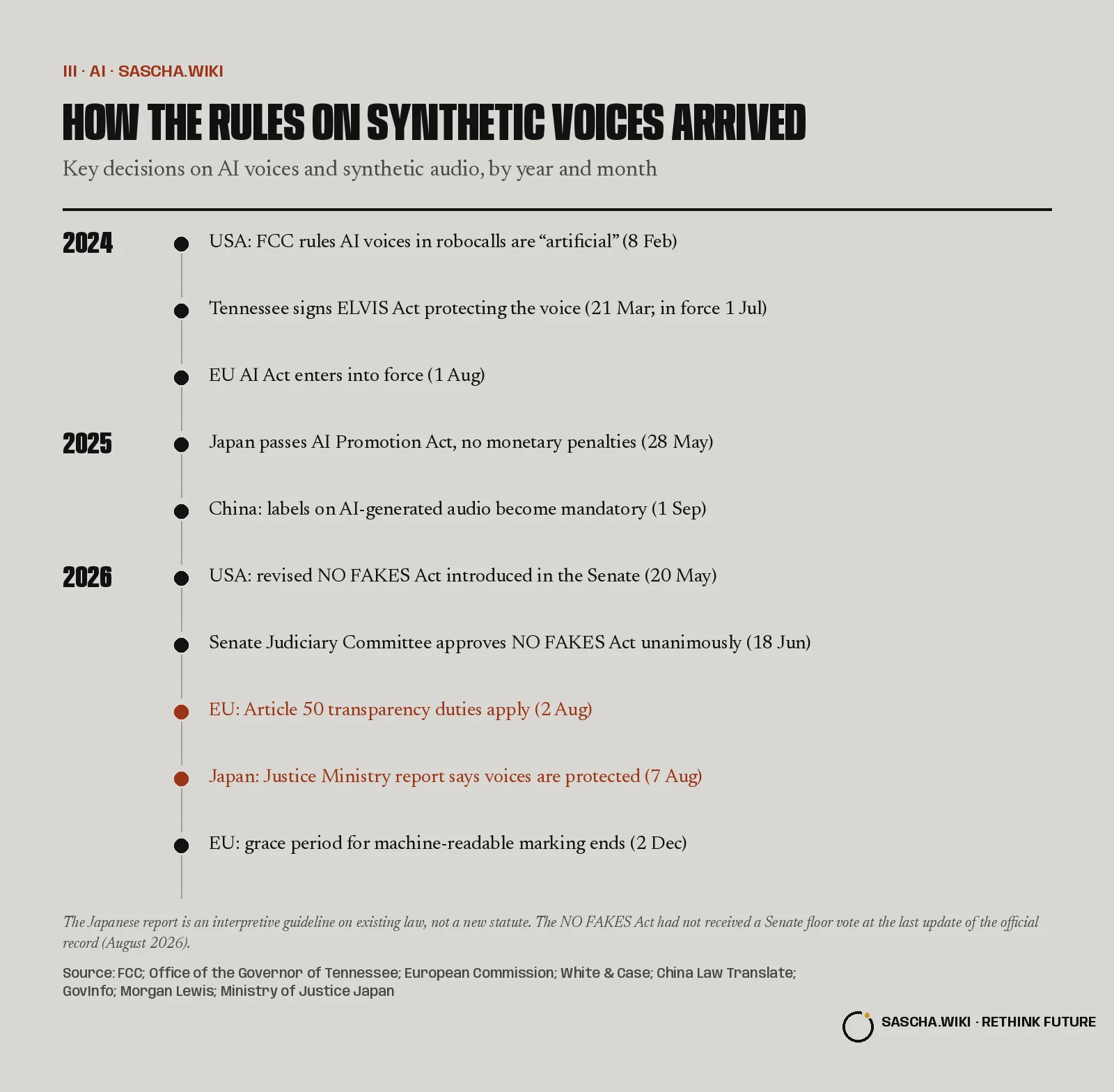
In January 2024, voters in New Hampshire picked up the phone and heard what sounded like President Joe Biden telling them not to vote in the primary. It was not him. It was a synthetic voice1. Within weeks the Federal Communications Commission ruled unanimously that AI-generated voices count as “artificial” under the Telephone Consumer Protection Act, which means such calls require the prior consent of the person being called. The ruling was adopted on 2 February and released on 8 February 20242.
The thesis here is simple: in the age of cloning, a voice is protected less by copyright than by consent, and the rules now arriving in Europe, America and Japan all rest on that idea.
A voice is not a work
Copyright was built for things people make: songs, books, photographs. A voice is something people are. The timbre, the hesitation before a difficult word, the way a vowel stretches at the end of a long day: none of that is a work in the legal sense, which is why the old instruments fit so poorly. The practical gap shows in the products. When Consumer Reports examined six voice-cloning services in March 2025, it found that four of them took no meaningful steps to stop people cloning a voice without permission3. At ElevenLabs, Lovo, PlayHT and Speechify, a ticked box, the user’s own assurance of having the right, was enough4.
Europe labels, America legislates
The European Union has chosen transparency. Article 50 of the AI Act, which entered into force on 1 August 20245, has applied since 2 August 2026. Providers of systems that generate synthetic audio, images, video or text must mark the output in a machine-readable way as artificially generated; those who deploy deepfakes must say so openly. Under the so-called digital omnibus, providers whose systems were already on the market before that date have until 2 December 2026 to add the technical marking, while the duty to disclose was not postponed6. The law, as usual, arrives in a good suit and slightly late.
The United States is working through the states and the courts. Tennessee’s governor signed the ELVIS Act on 21 March 20247. In force since 1 July 2024, it adds the voice to the rights a person holds over their own likeness and makes it actionable to distribute an unauthorised replica8. At federal level, a revised NO FAKES Act was introduced in the Senate on 20 May 20269. It would create a federal right over digital replicas of voice and likeness, with a notice-and-takedown procedure for platforms. The Judiciary Committee approved it unanimously on 18 June; at the last update of the official record it was waiting on the Senate calendar for a floor vote10. China, for its part, has required audible notices at the beginning, middle or end of AI-generated audio since 1 September 202511.
Whoever wants to use a voice needs the permission of the person it belongs to.
Japan’s patient version
Japan has preferred interpretation to new legislation. Its first AI law, passed by parliament on 28 May 2025, sets out principles and asks companies to make reasonable efforts, but carries no monetary penalties12. On the question of voices, the Ministry of Justice asked a panel of experts to clarify existing law rather than write a new one13. Its report, published on 7 August 2026, concludes that a voice is protected, like a name or a face, by the right of publicity and by personality rights, so that monetising an AI cover in someone else’s voice can be an infringement. Impressionists, the report adds, are generally not affected14. It is a quiet solution: no new statute, just a clearer reading of what was already there.
Consent as the new copyright
Put the pieces side by side and a pattern emerges. Europe insists that synthetic voices be recognisable as synthetic. America is moving towards a property-like right that can be licensed but not simply taken. Japan reads the protection into rights it already had. The instruments differ; the principle does not. Whoever wants to use a voice needs the permission of the person it belongs to. And whoever hears a machine speak has a right to know.
For the record: the audio versions of the essays on this site are read by a synthetic voice and are labelled as such.
Picture, then, a phone call a few years from now. A familiar voice, a little out of breath, asking for help. The technology to fake it will be better than it is today. What will have changed, if the rules hold, is the default: a voice used without permission is a voice taken, not borrowed. That is not a perfect defence. But it is a principle, and principles tend to outlast their software.
Sources
- Cooley: FCC: AI-Generated Robocalls Illegal Under the TCPA, 2024-02-15
- Federal Communications Commission: Implications of Artificial Intelligence Technologies on Protecting Consumers from Unwanted Robocalls and Robotexts, Declaratory Ruling (FCC 24-17), 2024-02-08
- Consumer Reports: New Report: Do These 6 AI Voice Cloning Companies Do Enough to Prevent Misuse?, 2025-03-10
- TechCrunch: Consumer Reports finds popular voice cloning tools lack safeguards, 2025-03-10
- European Commission: AI Act enters into force, 2024-08-01
- Morgan Lewis: EU AI Act’s Transparency Rules: What Went Into Effect on 2 August?, 2026-08-12
- Office of the Governor of Tennessee: PHOTOS: Gov. Lee Signs ELVIS Act Into Law, 2024-03-21
- Davis Wright Tremaine: Tennessee, All Shook Up Over AI-Generated Voice Replicas, Passes ELVIS Act, 2024-04-08
- U.S. Senator Marsha Blackburn: Blackburn, Coons, Salazar, Dean, Colleagues Introduce Revised Version of NO FAKES Act, 2026-05-20
- U.S. Government Publishing Office (GovInfo): Bill Status: S. 4591, NO FAKES Act of 2026, 2026-08-10
- China Law Translate: Measures for Labeling of AI-Generated Synthetic Content (translation; issued 7 March 2025, effective 1 September 2025), 2025-03-07
- White & Case: Japan’s first AI legislation becomes law: focus is on promoting research and development; no monetary penalties, 2026-04-14
- Ministry of Justice, Japan (法務省): 肖像、声等の無断利用による民事責任の在り方に関する検討会 (study group on civil liability for unauthorised use of likeness and voice), August 2026
- ITmedia AI+: 「声の無断利用」が権利侵害に 法務省が見解を明示 「AIカバー」も対象, 2026-08-07